The Machine Age · 25 October 1854
Half a League
A garbled order sends six hundred horsemen down the wrong valley
look closer
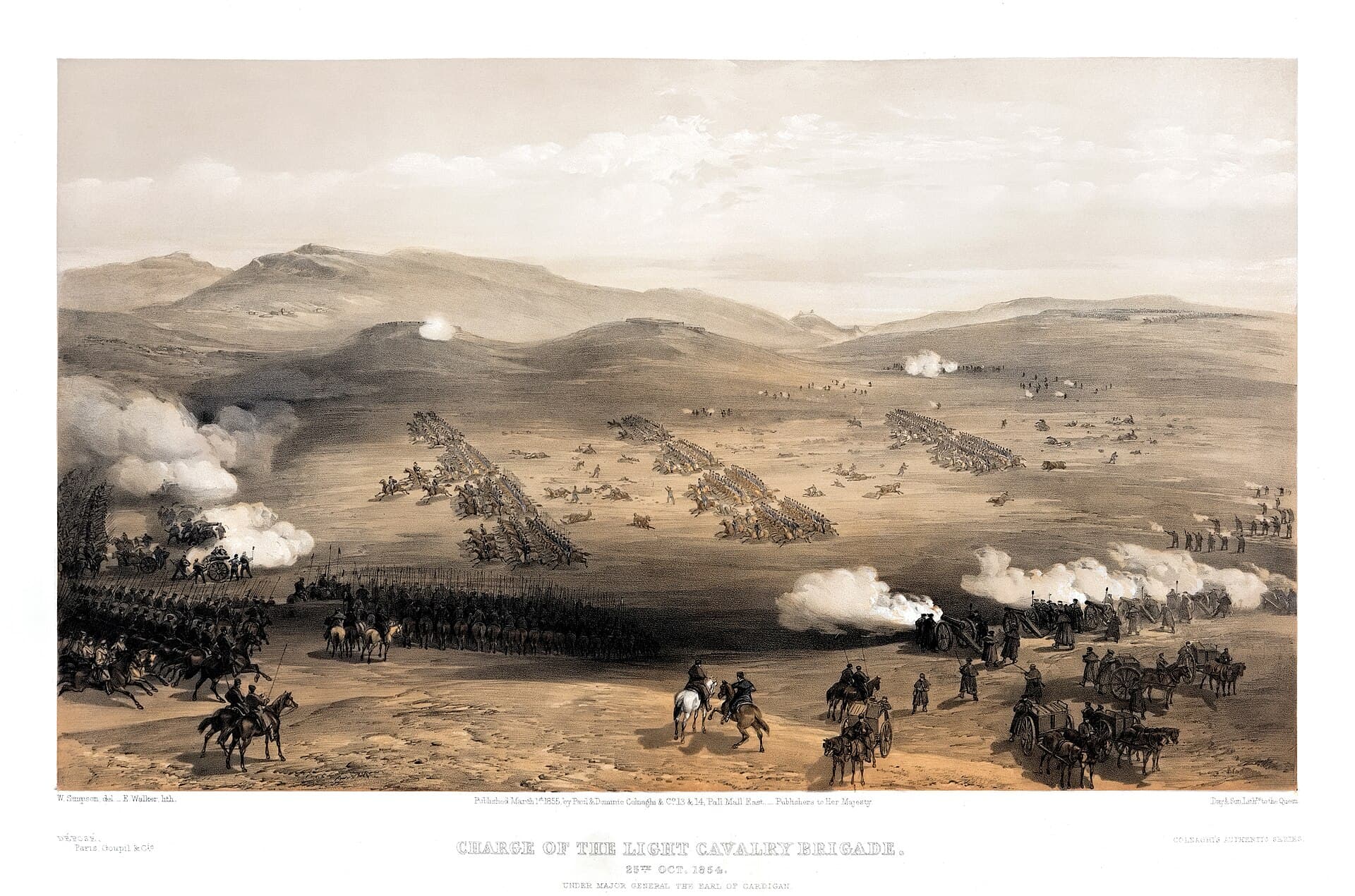
The 13th Light Dragoons and the 17th Lancers ride in the first line of the charge, across ground already covered with dead horses. Colnaghi sold a key plate with the print that named every regiment here and listed the officers. The list went down to Captain Webb, who died of his wounds.
At about eleven in the morning on the twenty-fifth of October, 1854, a written order came down the heights above Balaclava and stopped making sense on the way. Lord Raglan, watching the whole battlefield from a ridge, could see Russian gunners hauling off captured British guns and wanted his cavalry to stop them. His note said only to advance rapidly and prevent the enemy carrying away the guns. Down in the valley, the ground hid the guns Raglan meant. Lord Lucan read the same words and could see just one battery: a line of Russian artillery a mile off at the far end, with the whole Russian army behind it. He asked which guns. The officer who had carried the note was Captain Louis Nolan, a cavalry man with no patience for careful superiors. He flung out his arm toward the wrong end of the valley and said there was the enemy, there were the guns. So they went. About 670 riders of the Light Brigade, the finest light horse in the army, trotted then galloped down a mile of open ground with Russian batteries on three sides. Nolan rode out ahead, perhaps realizing the mistake, perhaps trying to turn the line, and was killed by one of the first shells before he could say a word. The rest kept on into what a French general watching from the flank called magnificent, but not war. They reached the guns. They cut down gunners, scattered cavalry behind the battery, and then, with no support and no reason to stay, turned and rode the same mile back through the same fire. It lasted about 20 minutes. About 110 of the men who started were killed and another 130 wounded. Some 60 were taken prisoner, and 335 horses were killed or had to be destroyed. The brigade as a fighting unit was gone by lunch. Back in England, the disaster became glory almost at once. The Times correspondent William Russell had watched it happen and wrote it up for readers at breakfast. Six weeks later Alfred Tennyson read the account, caught on the phrase someone had blundered, and wrote his poem in a few minutes. Theirs not to reason why, it went, theirs but to do and die. The nation chose to remember the courage and forget, mostly, the arithmetic of who had blundered. William Simpson was in the Crimea as a war artist, sent out by a London print seller to sketch the campaign for people at home. His view of the charge was one of the first pictures the public saw. He worked from the ground itself and from officers’ accounts. He drew the brigade small and far off, its lines strung across bare open country, with dead horses lying between them and the guns firing in from the flanks. Lucan and Cardigan, the brothers-in-law who between them had launched the charge, spent the rest of their lives blaming each other in print. Nolan, the one man who might have explained what he meant by that sweep of his arm, was buried in the Crimea, his intention gone with him.