The Machine Age · 3 July 1863
The High Water Mark
12,000 men cross a mile of open field toward a small clump of trees
look closer
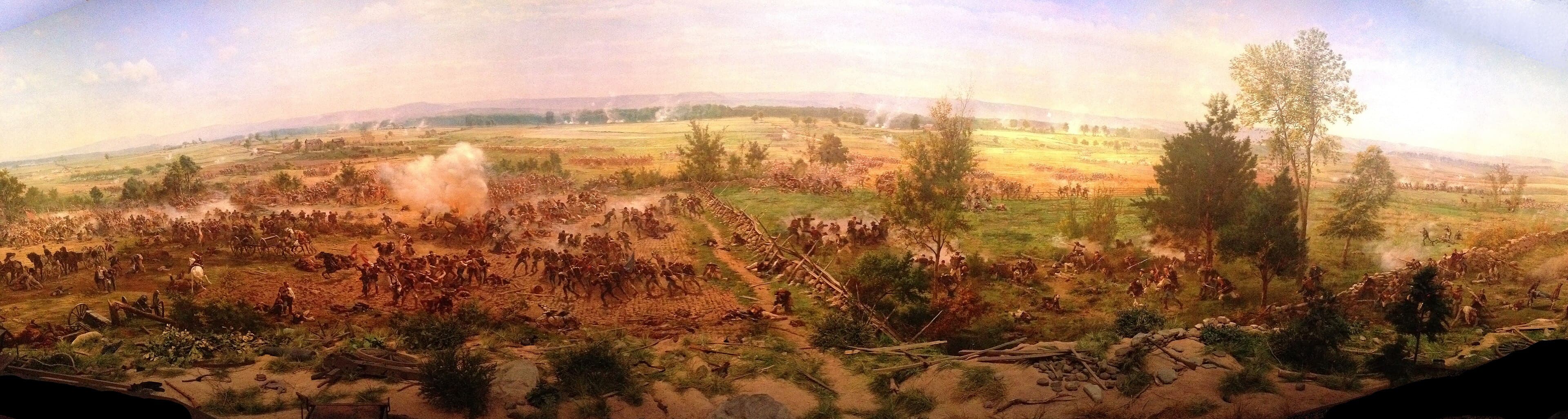
Musket barrels crowd along a low stone wall and fire over the top into open grass. This is the Union line the charge was aimed at. A few hundred men got over it before the counterattack closed in.
On the afternoon of the third of July, 1863, after two days of fighting outside the Pennsylvania town of Gettysburg, Robert E. Lee gambled the war on a single charge across open ground. For nearly two hours his guns hammered the low ridge where the Union army waited, the largest artillery bombardment ever heard on the continent, and much of it sailed long and hit empty grass. Then the guns went quiet. About 12,000 Confederate infantry stepped out of the tree line at the far edge of a field almost a mile wide. They dressed their ranks in the open as if on parade and began to walk toward the center of the Union line. Their aim point was a small copse of trees on Cemetery Ridge, a clump you could throw a stone across. They walked into converging fire from the first step. Artillery on the ridge switched to canister, which turned each cannon into a giant shotgun. Rifles opened along a mile of stone wall. Men fell in rows and the rows closed up and kept coming. A few hundred under General Lewis Armistead reached the wall and crossed it. Armistead held his hat up on the point of his sword so his men could see him. For a few minutes the fighting went hand to hand among the Union guns. Then the counterattack closed in from both sides, Armistead fell mortally wounded with his hand on a Union cannon, and the charge broke. Barely half the men who started across that field walked back. Lee rode out to meet the survivors and told them the fault was his alone. The copse of trees became the most argued-over patch of ground in the country. In the 1880s an iron fence went up around it to stop souvenir hunters carrying the trees away in pieces. A marker named it the high-water mark of the Confederacy, the farthest north the rebellion ever got. The war ran on for two more years. Veterans of both armies came back to walk the field and disagree about where exactly the line had held. The painting was never meant as a record. It was built to put a viewer inside the moment. Paul Philippoteaux was a Frenchman who painted cycloramas: canvases hung in a full circle, so the viewer stood at the center with the scene all around him. He spent months at Gettysburg with a photographer and a sketchbook, interviewing officers and mapping the ground. The finished circle ran 42 feet high and 377 feet around, and when it opened in the 1880s people wept and some old soldiers saluted the painted line. Philippoteaux put himself in it, a lone officer leaning against a tree with a sword. He painted four versions to meet the demand. The one at Gettysburg still hangs in the round, and the copse of trees stands in it exactly where the men were told to aim.