The Machine Age · 10 May 1869
Done in One Word
Two railroads meet in the desert and the whole country hears the hammer
look closer
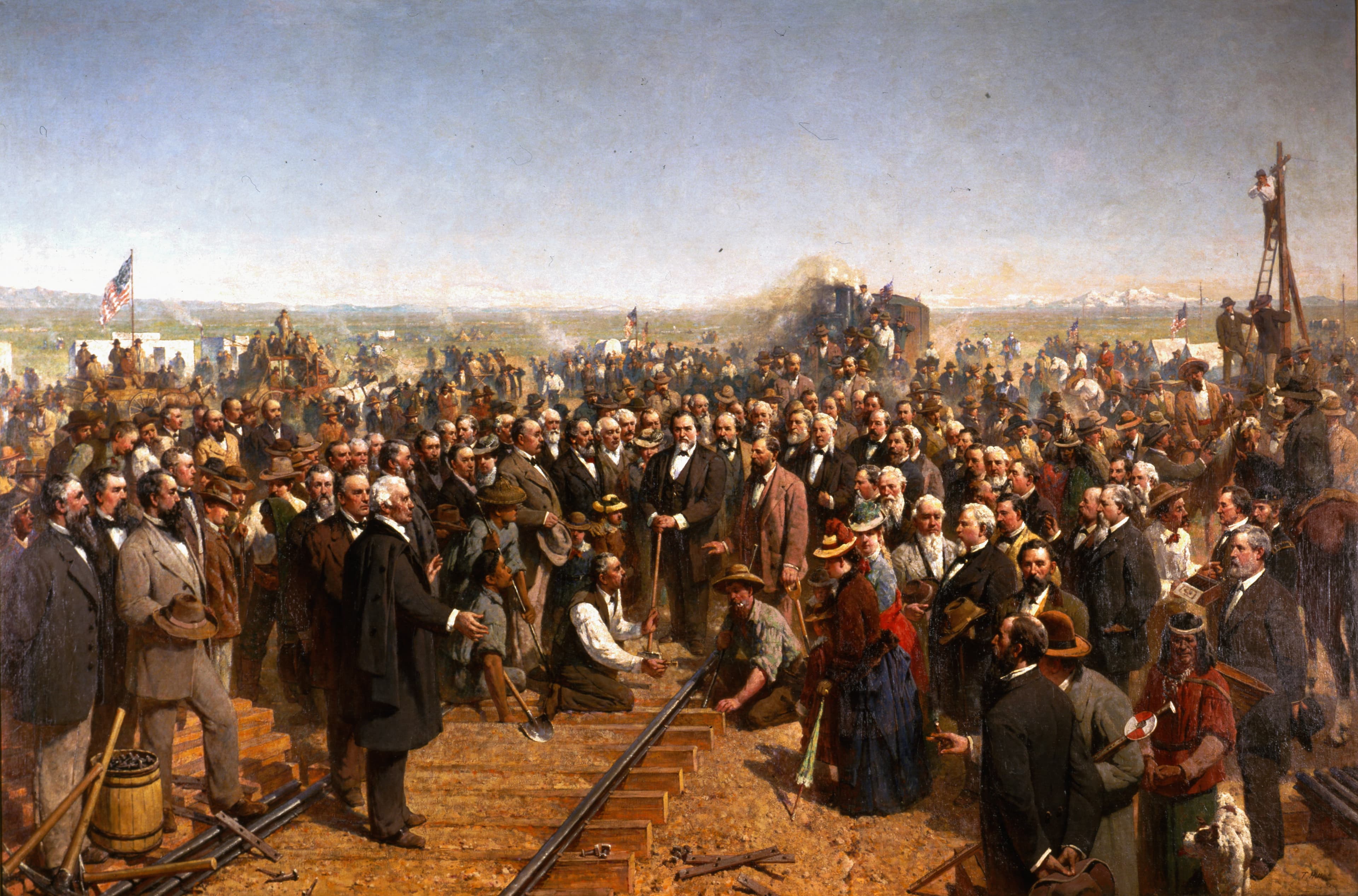
Two Chinese laborers stand over the last rail and one of them wears a woven straw hat. A grey-haired man kneels with the spike hammer. A Chinese crew of 8 laid this rail on the morning of the ceremony.
On the tenth of May, 1869, two locomotives faced each other across a single missing rail on a treeless rise in Utah called Promontory Summit. A crowd of a few hundred railroad men, soldiers, and reporters waited in the wind for one blow of a hammer. For six years the Central Pacific had blasted east out of California through the granite of the Sierra, and the Union Pacific had graded west across the plains. The last gap was now one length of track and a ceremonial spike of gold. A telegraph wire was clipped to the spike and to the hammer so the country could hear the join as it happened. Every blow would go out live down the wires. Leland Stanford, president of the Central Pacific, swung first and missed the spike entirely, hitting the rail. The telegraph operator, unwilling to wait on a governor’s aim, simply tapped out the message himself. One word went to both coasts at once: DONE. San Francisco fired its guns. Chicago threw together a parade 7 miles long, and in Philadelphia they rang the bell in Independence Hall. The two engines, the Central Pacific’s Jupiter and Union Pacific number 119, then rolled forward until their cowcatchers nearly touched, and the crews passed a bottle of champagne between them. The gold spike was pulled straight back out and replaced with an iron one. It was never meant to stay in the ground. The men who had actually laid the rails were mostly not in the photographs. Thousands of Chinese laborers had cut the Central Pacific’s roadbed through the mountains for lower pay and worse odds, and a crew of 8 of them laid the final rail that morning. When the ceremony was arranged, they were moved aside. A single line in one account notes a foreman calling them up to be thanked, and then the cameras looked the other way. The grand painting of the moment is a fiction assembled after the fact. Stanford commissioned Thomas Hill, a landscape painter, to record the scene, and Hill worked for years from photographs and portraits. He packed the canvas with about 400 figures, 70 of them portraits of named men. Many of those men were nowhere near Promontory that day. Stanford wanted the founders and financiers present in paint whether or not they had come. Two Chinese workers are in the picture, down at the rail with a shovel and an iron bar, hemmed in by frock coats. Stanford then refused to pay for the picture he had ordered. Hill had given it four years and his own money, and the bill for the day the country was sewn together went unpaid.