The Machine Age · 25 June 1876
Two Hundred Sketches
On a Montana hillside a column is surrounded and gone within the hour
look closer
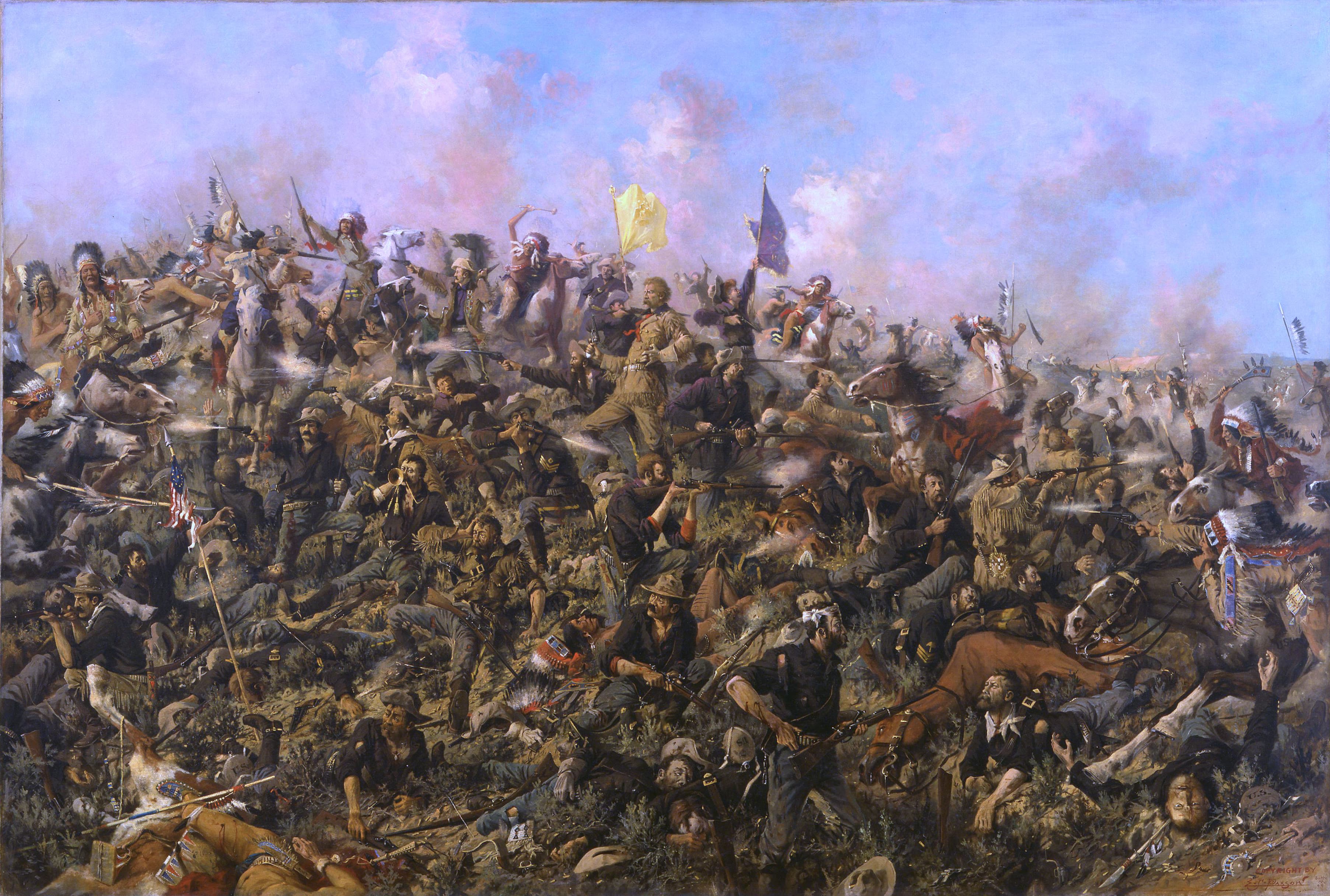
Custer stands at the center in buckskin, his revolver down at his hip. A warrior swings a stone club behind him. Almost nobody on Custer’s side lived to describe these minutes, so Paxson built them from what the winners told him.
Around three in the afternoon on the twenty-fifth of June, 1876, five companies of the Seventh Cavalry under George Armstrong Custer rode into the largest gathering of Plains warriors anyone would ever see. They were on a bare ridge above the Little Bighorn River in Montana Territory, and they had perhaps an hour to live. Custer had split his regiment into three parts and attacked a village he could not properly see, an encampment of Lakota, Cheyenne, and Arapaho holding several thousand fighting men. Sitting Bull had drawn them together and, in a sun dance weeks before, had seen soldiers falling into camp upside down. Crazy Horse led a wing of the counterattack that swept up and around the ridge. The soldiers shot their own horses for cover and fought on foot in shrinking knots. Within the hour Custer and every man of his immediate command was dead, about 210 of them, on a slope that is still marked today with white stones where the bodies were found. It was the worst defeat the United States Army suffered in all the wars against the Plains nations. The news landed in the papers in the first week of July, in the middle of the country’s hundredth birthday. The public wanted a hero and a last stand, and got both, whether or not the ground supported the story. Almost no one who could describe the final minutes had survived on Custer’s side. The fullest accounts came from the warriors who won. Edgar Paxson was a young sign painter and militia scout in Montana when the news came, and the battle took hold of him and would not let go. He gave it 20 years. He wrote to survivors on both sides and interviewed the Lakota leaders Gall and Rain-in-the-Face, and, he claimed, Sitting Bull himself. He walked the ground and spoke with dozens of soldiers who had ridden with the other columns. He wanted every uniform button and feather right. When he finally began the canvas around 1895, he sketched each figure on its own sheet before committing it, and the finished painting holds more than 200 separate men, no two poses alike. The picture Paxson delivered in 1899 is 6 feet by 9 and reads as a single roar of dust, smoke, war clubs and carbines. Custer stands high in the middle of it in buckskin with a pistol, ringed and almost swallowed. It is not what a camera would have caught, and Paxson knew it. He built the moment the country wanted to believe out of 20 years of asking the people who were there. He painted the words COPYRIGHT BY in red across the bottom corner, above his signature. He kept the 200 sketches. Each one is a portrait of a man he had good reason to think was on that hill.