Ancient Rome · AD 272
The Queen's Last Look
The chains are gold, and the escort is waiting on the stair
look closer
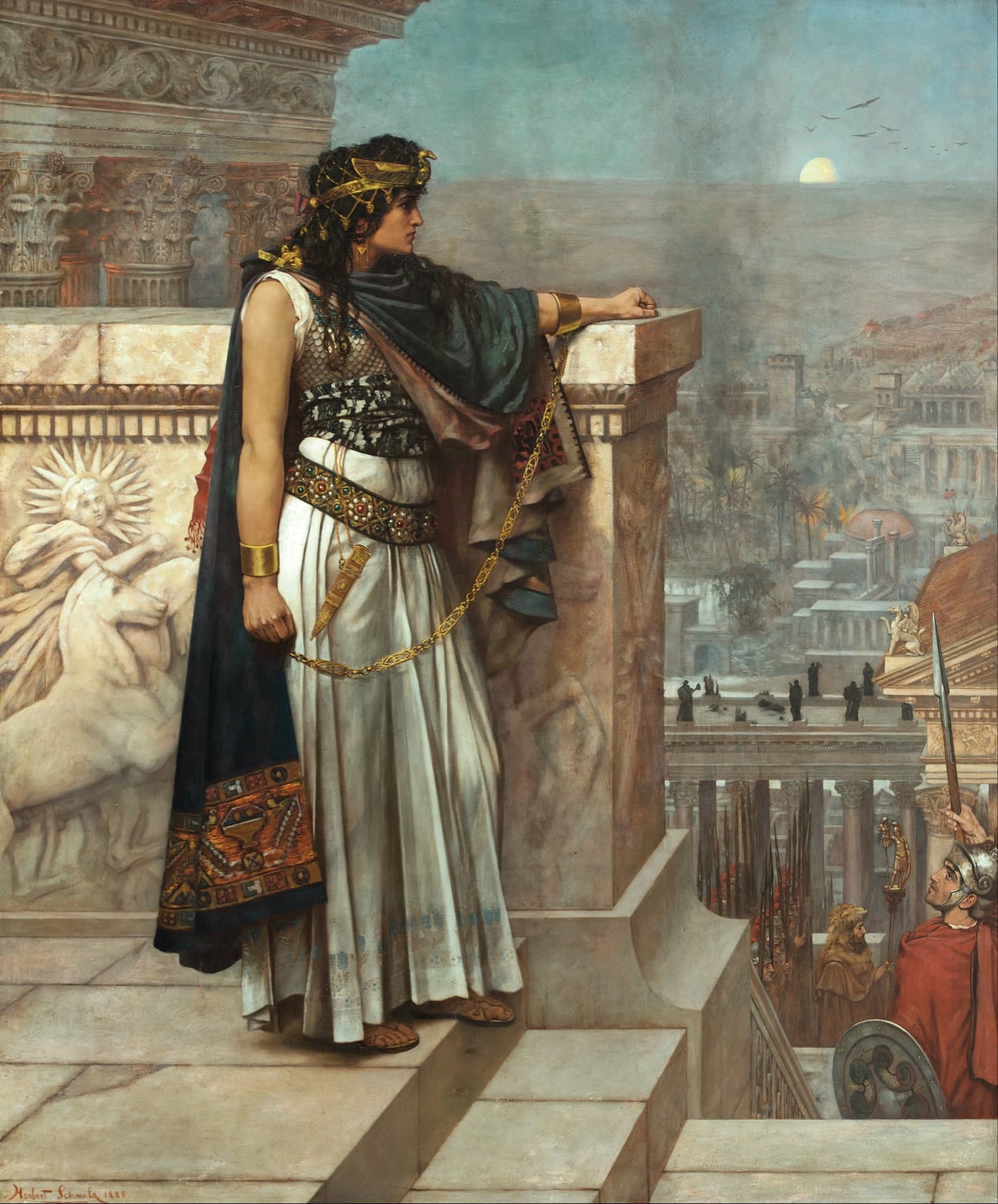
The cuff on her raised wrist has a chain hanging off it, and there is a second cuff on the hand at her side. She still has the jewelled belt and the dagger, and Aurelian is keeping her for the parade.
Palmyra was the toll booth of the world, an oasis city between the two empires. The silk, pearls, and incense of the East paid their way across it to the Mediterranean. Its merchant princes built colonnades with the percentage. When the Persians captured the emperor Valerian alive in 260 and the Roman East fell open, it was Palmyra's lord Odaenathus who drove them back, with Rome's thanks and Rome's titles. Then he was assassinated, and his widow took over as regent for their 10-year-old son. Her name in the inscriptions is Septimia Zenobia. She hunted like a soldier, ran a court with a Greek philosopher in residence, and claimed descent from Cleopatra, which was ambitious in every direction at once. In five years she took most of the Roman East. Her armies occupied Egypt, which fed Rome, and her authority ran through Syria and deep into Asia Minor. The mints told the constitutional story in metal. They struck her son's face beside the emperor's, then her son's alone, then hers, with the title Augusta. Rome in those years was a corridor of short-lived soldier emperors, and the gamble that no one would find time for the desert was nearly right. The man who found time was Aurelian, a Danube officer of no family who was reassembling the broken empire piece by piece. In 272 he beat her field armies twice, outside Antioch and at Emesa, and shut her inside Palmyra. She went out through the siege lines at night on a racing camel, riding for Persia and another war chest, and was taken at the Euphrates with the far bank in sight. Aurelian executed her philosopher Longinus, blaming him for the letter of defiance she had signed, and kept the queen herself for the parade. The triumph of 274 showed her to Rome in chains of gold, weighed, the chronicle says, with so many jewels she could barely walk. What came after is disputed in the sources and was probably ordinary: a villa at Tivoli, a marriage into the Senate, daughters. Rome preferred its monsters domesticated. Palmyra revolted again within the year, and Aurelian came back and took the city's future away for good; the caravans found other roads, and the colonnades kept only the sand. Schmalz painted her in 1888 at the hour between the two endings. She stands on a terrace above the colonnades, a pale disc low on the desert horizon, the gold cuff and its chain already on her wrist. At the foot of the stair a Roman escort knows better than to hurry her. The South Australian government bought the canvas in 1890, and it has hung in Adelaide ever since.