Ancient Rome · c. AD 220
The Weight of Roses
Dinner with the teenage emperor is not always survivable
look closer
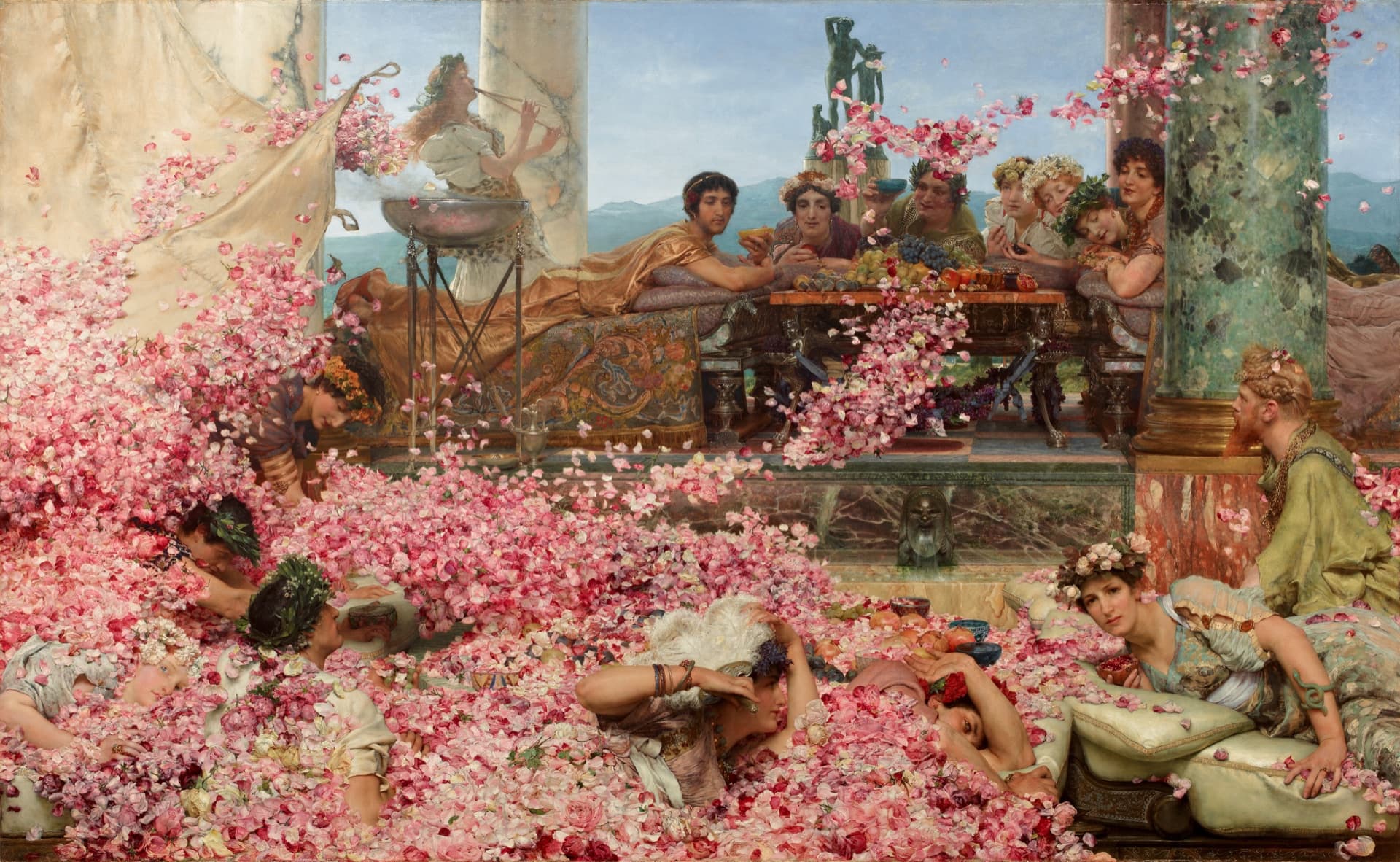
The host lies propped on one elbow in gold silk and watches the table. A shallow gold bowl rests in his hand. He was put on the throne at 14 and killed in a palace latrine at 18.
The emperor is 17 and the ceiling is rigged. His guests recline under a false canopy while the courses go around. At the hour of his choosing the panels tip and the flowers come down. Not a scattering but a fall, armfuls of it, until the couches disappear. The Historia Augusta, Rome's least reliable and most readable chronicle, says some guests could not struggle out from under and smothered in perfume. It also says the flowers were violets and others; the roses are the painter's. He was born Varius Avitus Bassianus in Emesa in Syria, hereditary boy priest of the sun god Elagabal. He became emperor at 14 because his grandmother told the legions he was the natural son of the murdered Caracalla, whom the soldiers still loved. They took the hint and removed the sitting emperor. The boy came west with the god itself in his baggage: a black conical stone, carried under silk canopies. He installed it above Jupiter in a temple on the Palatine and danced for it in the mornings. Rome had absorbed strange rulers before; it had never watched one marry a Vestal Virgin, which he did, twice over among his four or five marriages in four years. The dinner table was where his imagination did its governing. The chronicle's catalogue runs long: guests waking from wine among tame lions and leopards, air cushions that sighed flat under sleepers, banquets in a single color, invitations that were themselves the joke. The flower fall belongs to this list, written a century and a half later by an author who embroidered freely, and none of it can be checked. All of it was believed, which is its own kind of record: the reign made every story about it plausible. The Praetorians killed him in a palace latrine at 18, dragged the body through the city, and put it in the Tiber, and the Senate scraped his name off the inscriptions. Alma-Tadema took up the legend in 1888, on a commission from the engineer Sir John Aird. Through the winter he had fresh roses shipped up weekly from the Riviera, so that every petal in the avalanche could be painted from life. The emperor reclines in gold silk at the high table, propped on one elbow, watching. No one in the painting is dead yet. Alma-Tadema chose the minute in which the flowers are still delightful and left the rest outside the frame.