The Renaissance · 1555
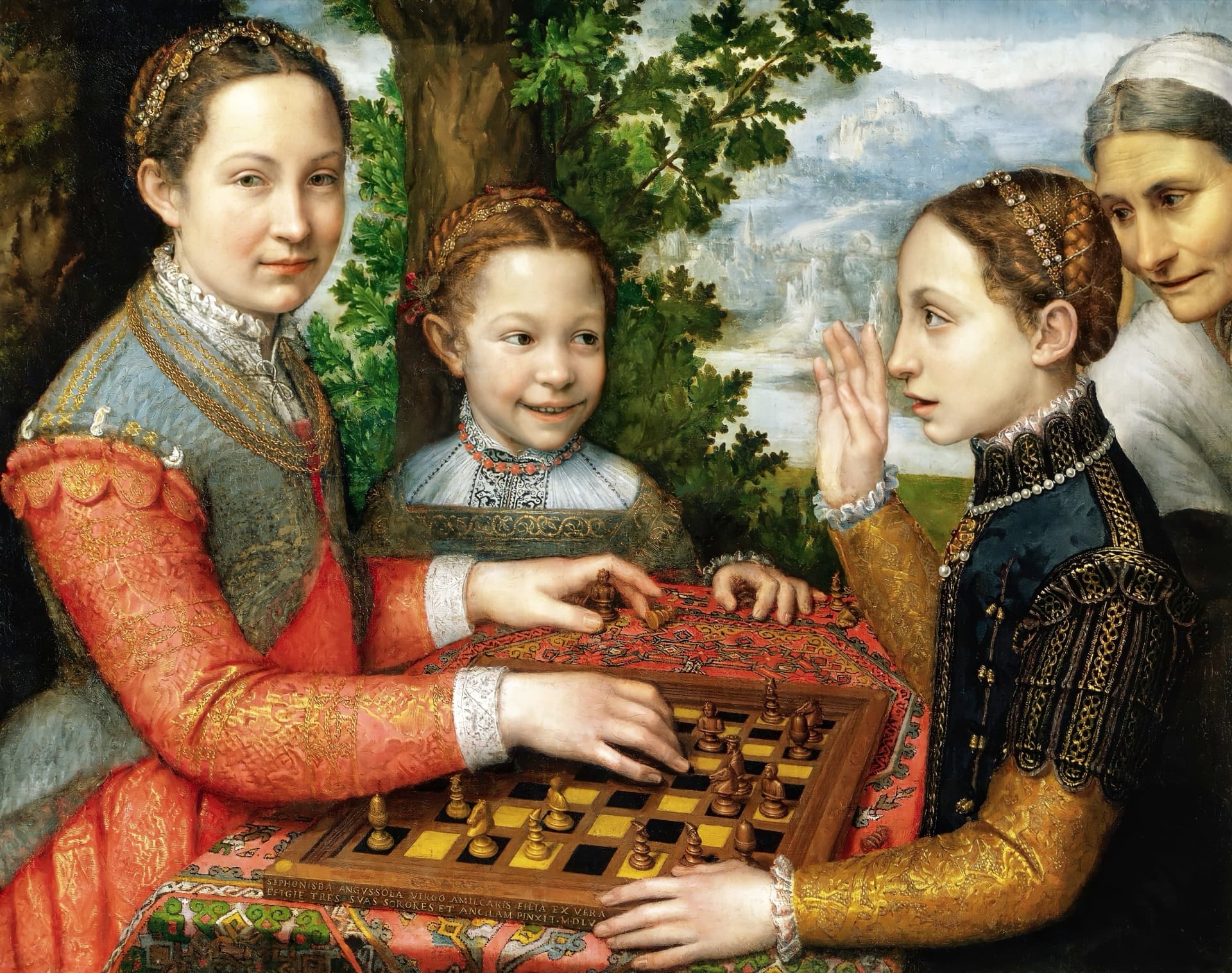
The Sisters at the Board
A game of chess argues that women can paint
look closer
The eldest of the three players has turned from the game to look straight out of the picture. This is Lucia, and her mouth stops just short of a smile. Sofonisba painted her own household, because women were barred from drawing nude models and from the anatomy room.
Amilcare Anguissola, a minor nobleman of Cremona, ran a household experiment a century ahead of schedule. He gave his six daughters the full humanist education normally reserved for sons: Latin, music, and, for the ones who wanted it, painting. The eldest, Sofonisba, wanted it entirely. As a woman she was barred from studying anatomy or the nude, the standard ladder to the grand style. So she aimed her training at the one subject fully available: the people at her own dinner table, caught alive. In 1555, in her early twenties, she painted three of her sisters playing chess under an oak. On the edge of the board she signed it in Latin: Sofonisba Anguissola, virgin, daughter of Amilcare, painted her three sisters and a servant from life. Painted from life is the manifesto. Lucia, on the left, has just taken a piece, and she looks out of the picture with the mild certainty of an older sister who is winning. Little Europa in the middle grins openly at the loser. Minerva, caught mid-objection, raises a hand, and the servant leans in over her shoulder. Nobody poses. It is one of the first paintings in European art in which a family is doing something rather than sitting for something. Visitors noticed. Vasari, detouring to Cremona a decade later, wrote that the figures lacked only speech. The career that followed ran through the front doors of places women did not enter. Michelangelo, shown her drawing of a laughing girl, sent a test back from Rome: draw a boy crying, which is harder. She answered with her small brother Asdrubale howling over a finger nipped by a crayfish, and in 1562 that sheet went to Cosimo de' Medici in Florence, packed alongside a Michelangelo. Caravaggio lifted the idea decades later. She was 27 when Madrid called her as court painter and lady-in-waiting to the queen of Spain. She spent 14 years painting the most guarded family in Europe. A lady of the household could not take painters' fees or sign like a tradesman, so her royal portraits went unsigned. For centuries the best of them were credited to men. Museums have spent the last several decades amending labels. She outlived nearly everyone in the story. In her nineties, in Palermo, she received a young Flemish visitor named Anthony van Dyck. He sketched her in his travel notebook and put her age down as 96. He also wrote out her advice: keep the light low, or the shadows in the wrinkles of an old face grow too large. He had taken more good counsel from a blind woman, he noted, than from the works of famous painters. Her eyes were failing; her opinions were not. The chess game hangs in Poznań, signed along the edge of the board.