The Renaissance · 1548
The Saint Fell Headfirst
A dyer's son drops a miracle into Venice at full speed
look closer
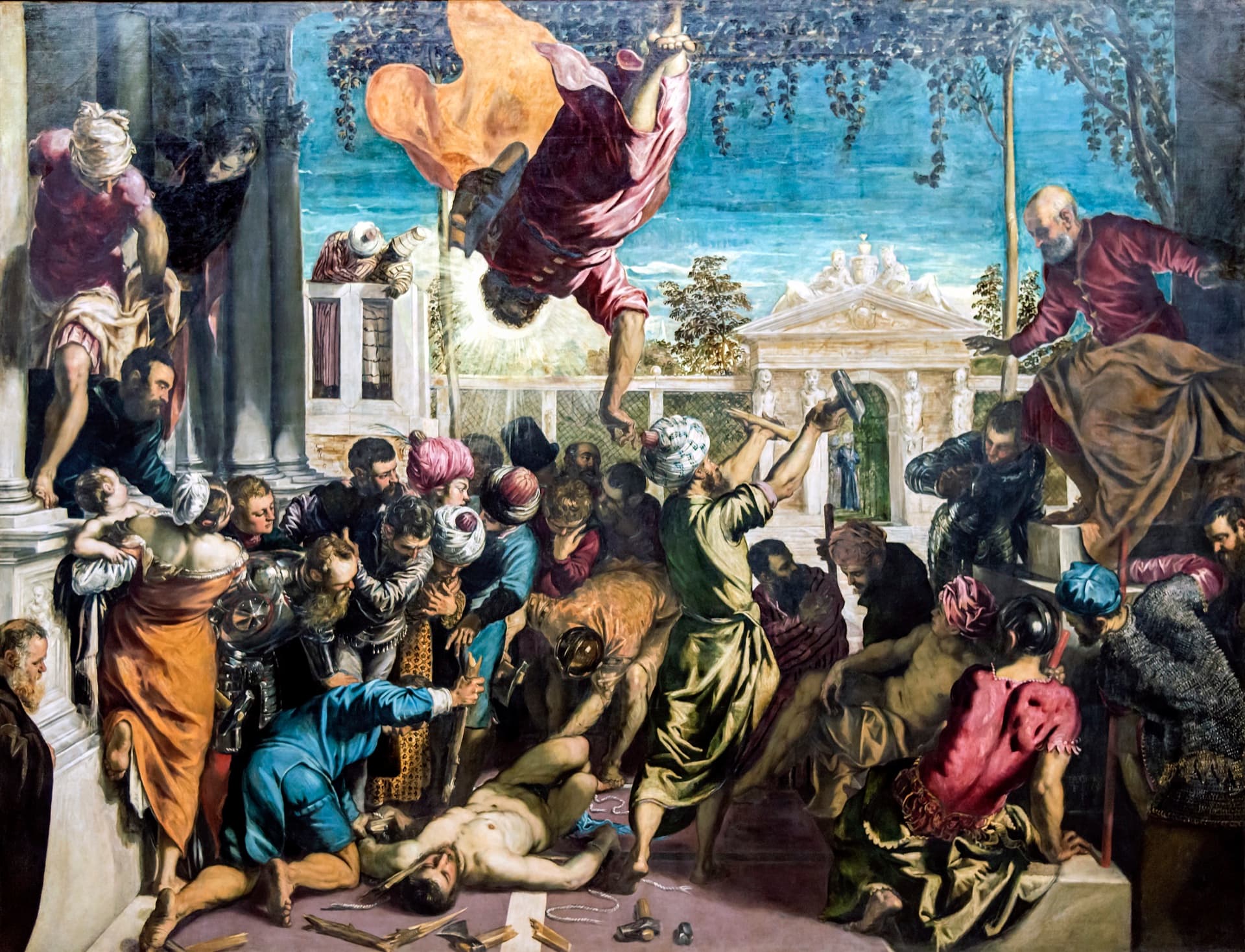
Mark comes down head first, with his robe hauled up around him. One bare foot still points at the sky. The men below have not looked up.
Jacopo Robusti was the son of a cloth dyer, a tintore, and Venice never let him forget it: the name he worked under his whole life, Tintoretto, means the little dyer's boy. The story his first biographer tells is that Titian took him in as a student and expelled him within days, seeing the drawings; whether from jealousy or temperament, master and boy were enemies ever after. Shut out of the establishment, he trained himself, and on his studio wall he wrote the program: the drawing of Michelangelo and the color of Titian. He got his first great public stage in 1548. The Scuola Grande di San Marco, one of the rich brotherhoods that ran charitable Venice, wanted a miracle of its patron saint for the meeting hall. Tintoretto was about 30. The legend he was given was tame enough on paper. A servant goes to pray at the relics of St Mark against his master's orders, and is sentenced to have his eyes put out and his legs broken. The tools shatter in the executioners' hands. Every other painter in Italy would have put the saint on a cloud, blessing from a respectful altitude. Tintoretto threw him out of the sky headfirst, upside down, angled like a diver a yard above the crowd, robes on fire with light. He is invisible to everyone in the painting and unmissable to everyone outside it. Below him the slave lies stripped across the front of the picture, his bare body lit and solid as a fallen statue. A turbaned executioner holds up a shattered hammer to the master on his raised chair. He has the look of a workman whose tools have failed him for no reason he can name. The confraternity brothers quarreled over the picture; some found it indecorous, too violent, too new, and the aggravated painter took it back for a time before the faction that understood what they had prevailed. From that canvas forward the commissions never stopped. Venice nicknamed him Il Furioso, the furious one, for the speed. Years later the Scuola di San Rocco held a competition for a ceiling sketch. Tintoretto skipped the sketch, painted the finished picture, had it secretly installed, and then donated it outright, knowing the rules forbade refusing a gift. The other competitors went home. The Miracle of the Slave hangs now in the Accademia, a few minutes' walk from where it scandalized its first committee. It keeps the quality that upset them: a painting arriving at speed, brakes off. French troops took it to Paris in 1797. Venice got it back in 1815, and it has not left the city since.