Classical Greece · c. 530 BC
The Sunrise Society
A brotherhood in Croton wakes before dawn to sing the sun up and count the world
look closer
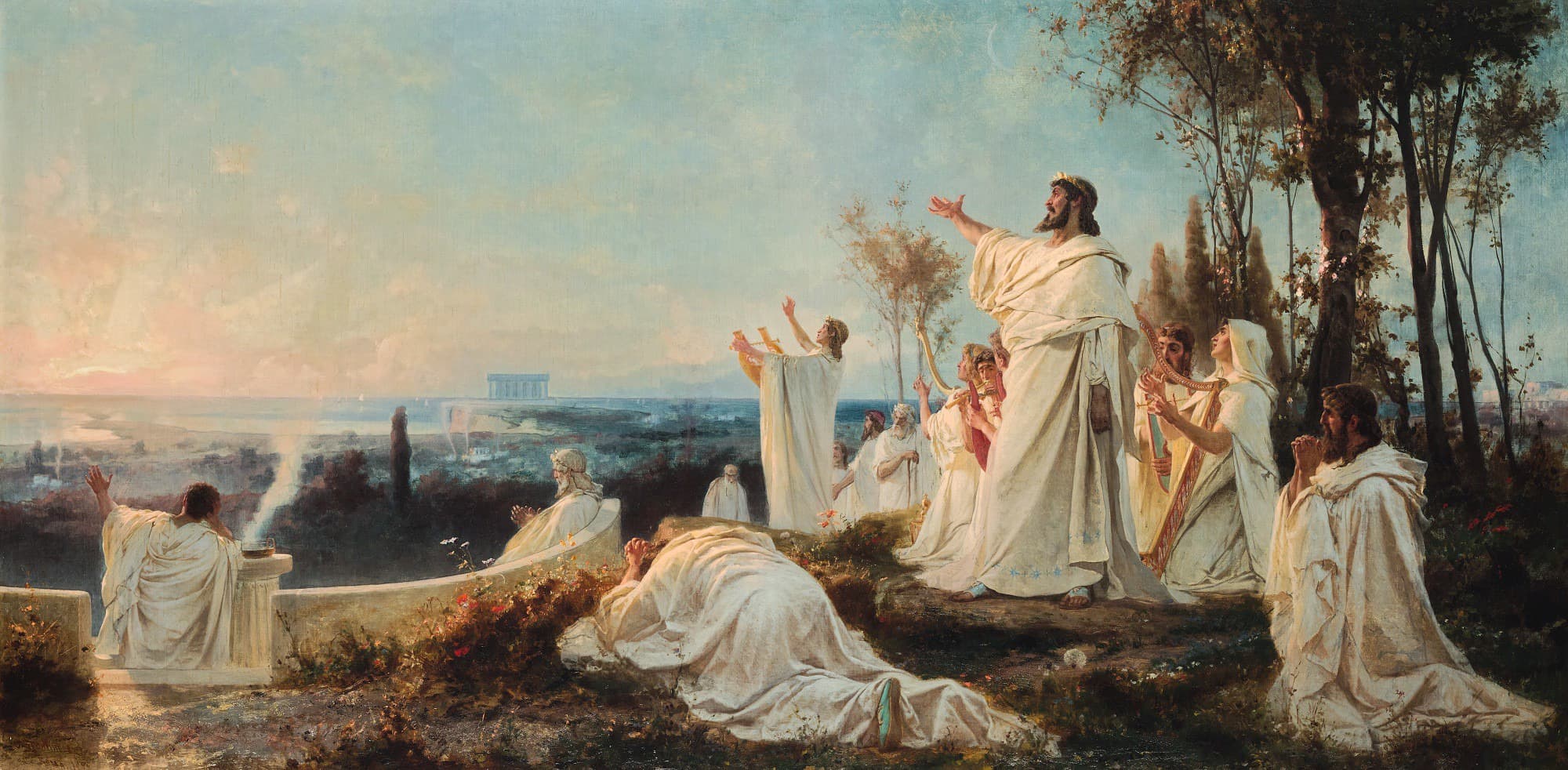
The man leading the hymn flings an arm at the first light. A gold wreath is pushed into his hair. Iamblichus says a Pythagorean spoke to nobody in the morning until he had first walked alone and made music.
Before dawn on the high ground above Croton, in the Greek far west that is now the toe of Italy, men in white walked out alone, each on his own path. Iamblichus, who gathered the order’s lore centuries later, says a Pythagorean spoke to no one in the morning until he had put his own soul in order. First a walk alone, then music, and only then other people. Pythagoras had arrived around 530 BC from Samos. He left the island, the tradition says, because the tyrant Polycrates made thinking out loud a poor idea. What he founded at Croton was something Greece had not seen before: a school run like a monastery, with political ambitions. Joining was slow by design. Newcomers kept a silence some sources stretch to five years; property went into common keeping; the day ran to a timetable of music, exercise, shared meals. The rules that leaked out to outsiders sound like riddles. Do not stir the fire with a knife. Do not step over a beam. Do not eat beans. They took that last one seriously. In the legend of the founder’s death he is fleeing armed men, stops at the edge of a bean field, refuses to cross it, and is cut down at its border. Diogenes Laertius collected the ancient guesses about what the beans meant, and none of them settles anything. Under the riddles sat one conviction: number is the skeleton of the world. The oath of the order named the tetraktys, the triangle of ten dots that stacks one, two, three, four. Proof was audible. Stop a string at half its length and it sounds the octave. At two thirds it sounds the fifth. Harmony is ratio, and if strings obey arithmetic the planets might too, spaced like string lengths, sounding a music too constant for anyone to hear. The theorem with his name on it is the odd item out. Babylonian surveyors were pressing right-triangle number sets into clay a thousand years before Pythagoras was born. What the school added was the demand for proof. He himself wrote nothing. He did teach that souls move from body to body, and he was mocked for it in his own lifetime. Xenophanes jokes about Pythagoras stopping a man who was beating a puppy: do not hit him, it is the soul of a friend, I knew him by the voice. It ended the way political clubs end. The Pythagoreans had drifted into running Croton. Their enemies, Iamblichus says, set fire to the house of Milo the wrestler, six times an Olympic champion, while the leadership met inside. The survivors scattered, and Pythagoras died in exile at Metapontum. The morning hymn outlived the politics by 24 centuries. Fyodor Bronnikov, a painter from Shadrinsk beyond the Urals who spent his working life in Rome, staged it in 1869 with harps and white wool on a terrace above the sea. That first version hangs in the Tretyakov in Moscow. This one he repeated himself, signed Roma, 1877, the sun just breaking the left edge of the canvas.