Classical Greece · September, 490 BC
Two Days to Sparta
Athens hands one man a message and he is in Sparta, 150 miles away, the next day
look closer
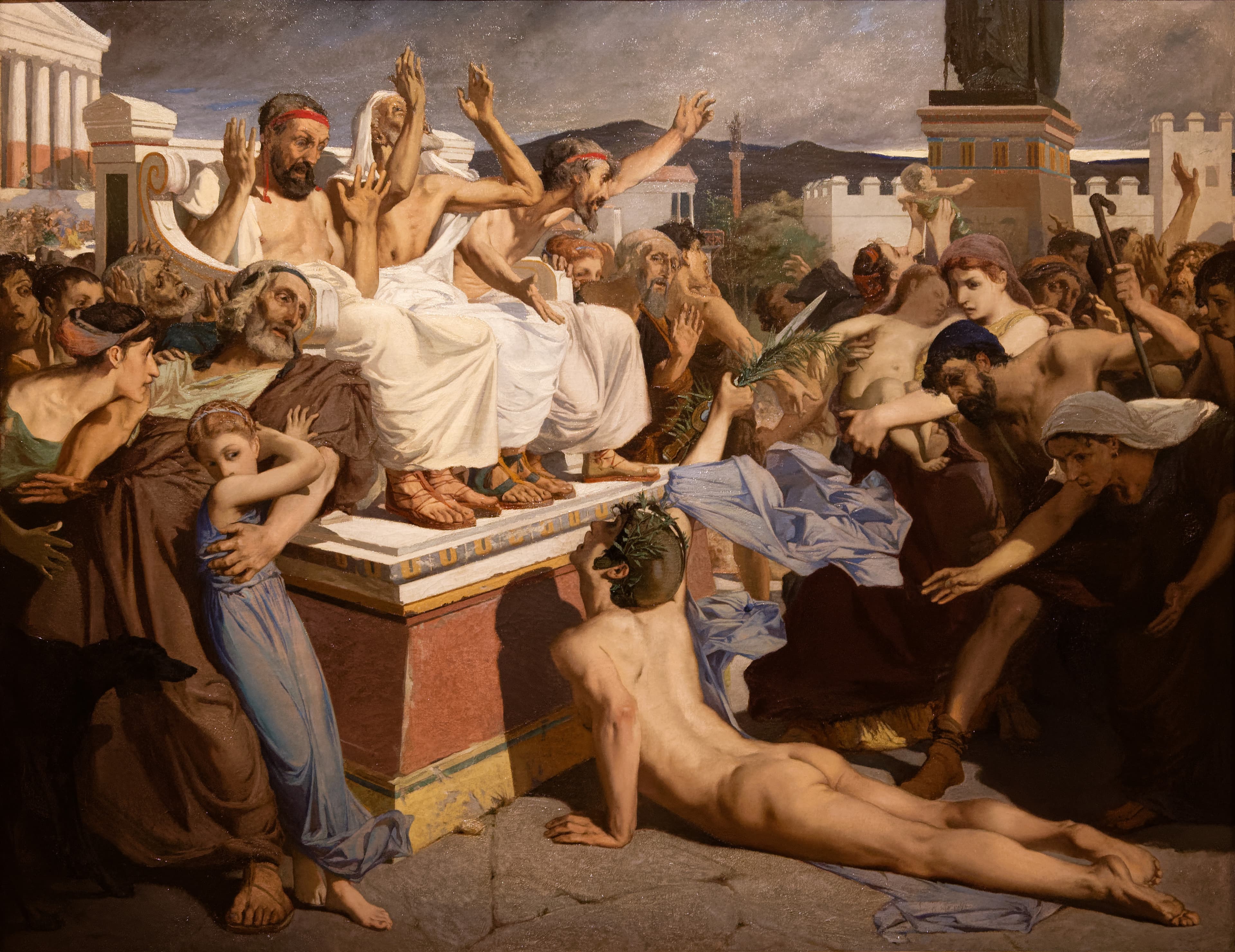
He announced the victory with the laurel already on his head. Then he dropped at the foot of the platform, under the magistrates’ feet. Six centuries after the battle, Lucian is the first to give him last words: joy, we win.
When the Persian fleet beached at Marathon, a long day’s march from Athens, the city sent for help the only way that existed: it handed the message to a man and told him to run. His name was Pheidippides, and running was his profession; Herodotus calls him a hemerodromos, an all-day runner, a job Greek states maintained for exactly this errand. The road to Sparta is about 150 miles, with the mountains of Arcadia in the middle. Herodotus reports the timing without ceremony: Pheidippides left Athens and was in Sparta the next day. He came back carrying two answers, one from men and one from a god. The Spartans would come, but not yet; they were keeping the Karneia, their festival of Apollo, and their law forbade marching until the full moon, six days off. The god was the stranger part. Crossing Mount Parthenion above Tegea, the runner said afterward, he met Pan. The god called him by name and asked, a little hurt, why the Athenians paid him no honors. He had been useful to them before, and meant to be again. Athens took the complaint at face value: after the war Pan got a cave sanctuary under the Acropolis and a yearly torch race. Herodotus passes the encounter along as the runner’s own account, and leaves it there. The battle would not wait for the moon. Roughly 10,000 Athenian hoplites charged the Persian line at a run, with every fighting man little Plataea had beside them. Herodotus says no Greek army had done that before. The wings folded in on the Persian center. The count afterward ran to Athenian exactness: 6,400 Persian dead against 192 Athenians, and the 192 went under a burial mound that has not moved from the plain since. The Spartans marched the morning after the full moon and covered the 150 miles in three days. All 2,000 of them walked the field among the dead, praised the work, and went home. The dying messenger is a later invention. Herodotus, who talked with the Marathon generation, has no runner dying over the word victory. What he has is the army itself marching hard back to Athens the same afternoon, to beat the Persian fleet to the harbor. A city saved twice in one day. The death-run enters the record about six centuries later: Plutarch names the runner Thersippus, or maybe Eucles, and Lucian is the first to hand the part to Pheidippides, with last words attached, joy, we win. That is the version Luc-Olivier Merson painted in 1869, at 23, and it won him the Grand Prix de Rome. The runner lies naked and finished at the foot of the magistrates’ platform, victory laurel on his head, the elders’ arms flying up. The École des Beaux-Arts keeps the canvas, as it keeps its winners. The modern race is a memorial to the legend, measured by accident. A French philologist, Michel Bréal, talked the 1896 Olympics into a race from Marathon to Athens and put up a silver cup, which a Greek water carrier named Spyridon Louis carried off. The distance then wandered from games to games until London in 1908. The start was laid on the lawn of Windsor Castle, beneath the windows of the royal nursery, and the finish sat opposite the royal box at White City. The sum came out at 26 miles and 385 yards, adopted as the fixed distance in 1921. Every marathon since is the length of a royal garden plus a lap of a vanished stadium. The run Herodotus actually recorded was six times as long.