Classical Greece · September, 480 BC
The Wooden Wall
Themistocles talks the Persian fleet into the narrow water where counting fails
look closer
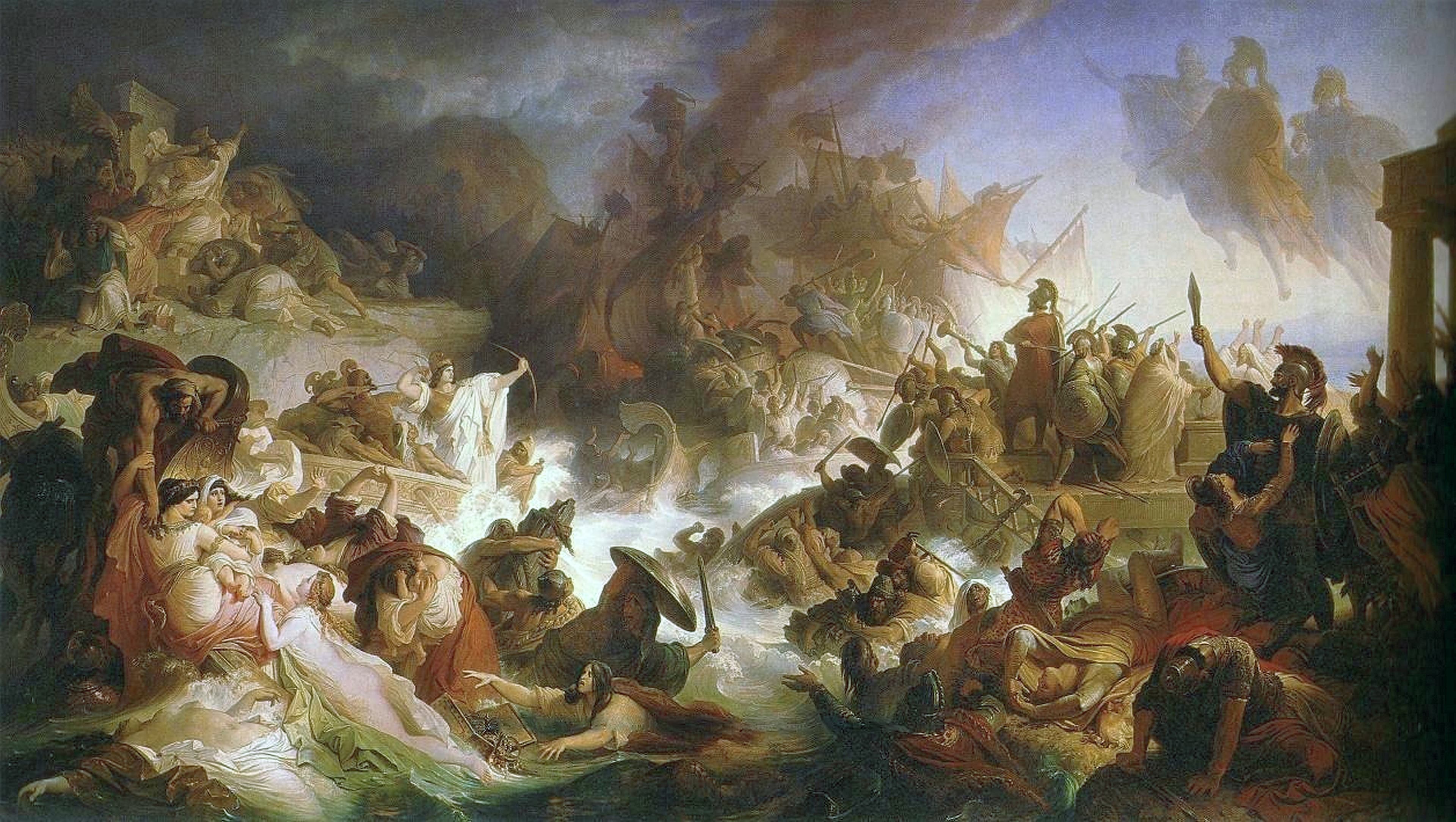
Two trumpets and a curved sword go up over the deck beside the commander in the red cloak. The crews take up the war hymn. Aeschylus fought in this water and kept the words: sons of the Greeks, go, free your fatherland, your children, your wives.
Three years before the battle, Athens struck silver. A rich new vein came in at the state mines at Laurion, and the assembly’s first instinct was to hand it out, 10 drachmas a citizen. Themistocles talked the city into spending the windfall on 200 warships instead. The ships were sold to the voters as insurance against the grudge war with Aegina next door; what Themistocles was watching was Persia. Delphi told the Athenians that only a wooden wall would stand unbroken, and ended the prophecy this way: divine Salamis, you will destroy the children of women. Themistocles argued down the professional interpreters. The wooden wall was the fleet, and an island fated to ruin Greeks would have been called hateful, not divine. The city voted his way twice, once for the ships, and once, when the invasion came, for emptying Athens and fighting from the water. By late September of 480 the surviving Greek fleet lay crowded in the channel between Salamis and the mainland, and the crews could watch the smoke going up from their own acropolis across the water. The war council nearly broke daily. Plutarch has the Spartan commander Eurybiades raising his staff at Themistocles in one session, and Themistocles answering: strike, but hear me. When Adeimantus of Corinth sneered that a man with no city behind him should keep silent, Themistocles said his city was the 200 manned ships in front of them. The allied vote kept drifting toward retreat to the Isthmus. So Themistocles arranged for the vote to stop mattering. At night he sent Sicinnus, the slave who tutored his children, rowing across with a private message for the king. The Greeks mean to slip away at dawn; close the exits and take them all. Xerxes believed it, because it was nearly true. The Persian squadrons rowed out in the dark to seal both ends of the strait and held station until morning, crews awake all night at the oar. At first light the Greeks came out singing the paean. Aeschylus, 45 that year and in the fight, later set down the words: sons of the Greeks, go, free your fatherland, free your children, your wives, the shrines of your fathers’ gods. His count of the fleets, 310 Greek ships against 1,207, is the nearest thing we have to an eyewitness ledger. In water a mile wide the Persian numbers became the Persian problem: the deep line fouled itself in the narrows, and the Greek triremes worked the edges of the crush ram first. Artemisia of Halicarnassus was the one captain Xerxes praised by name. She escaped an Athenian pursuer by ramming a ship on her own side, which went down with all hands. The king watched from a throne set on the slope of Mount Aigaleos, with secretaries writing down the name, father, and city of every captain who fought well. He took her victim for an enemy and said, Herodotus reports, my men have become women and my women men. Herodotus grew up in Halicarnassus, her city, which may be why she gets the best lines. Most of the Persian dead never reached a deck to die on; they could not swim. Xerxes went home before winter, leaving Mardonius to lose at Plataea the next summer, and the afterlives came out crooked. Themistocles, ostracized within a decade, finished his days as a Persian governor at Magnesia, salaried by the son of the king he had beaten; Sicinnus the tutor got citizenship at Thespiae and died rich. Aeschylus staged The Persians in 472. It is the oldest play that survives anywhere, and it is set not among the victors but in the enemy’s grieving court. Its chorus was paid for by a rising young man named Pericles. His own epitaph, which tradition says he wrote himself, mentions Marathon and the long-haired Mede and not one word about plays. Kaulbach painted the strait for the Maximilianeum in Munich, over 50 square meters of canvas, and hung the ghosts of the old Salamis heroes in the sky over the oar-smoke. The Bavarian parliament meets under that roof today.