The Machine Age · 5 January 1895
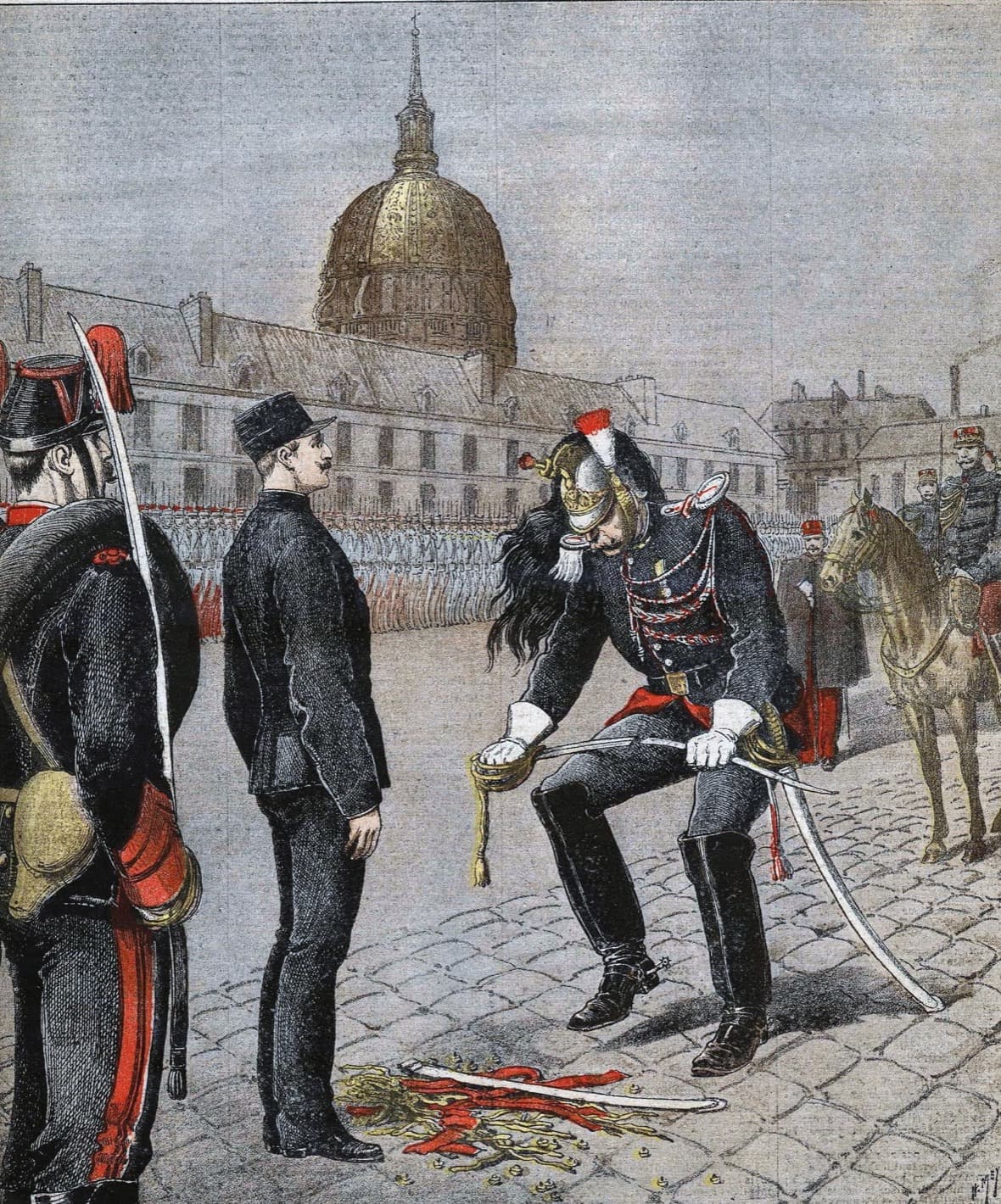
The Sword Broken in the Yard
An officer is stripped of his rank, and France cracks in half
look closer
White gloves hold the sword by the hilt and the blade. The adjutant has his knee raised to break it across. The blade had been sawn nearly through so it would snap on cue.
The ceremony took eight minutes in the courtyard of the École Militaire on the morning of 5 January 1895. Captain Alfred Dreyfus, 35, was an Alsatian Jew and a graduate of the artillery staff. He had been convicted of selling secrets to Germany on the strength of a handwriting comparison and a secret file his lawyer never saw. Now a giant of an adjutant tore the buttons, braid and insignia off his uniform and broke his sword across a knee. The sword had been sawn most of the way through beforehand so it would snap cleanly. The army had rehearsed all of it. As they marched him past the ranks, Dreyfus shouted that he was innocent, that they were degrading an innocent man, and long live France. Outside the railings a crowd chanted death to the Jews. He went to Devil's Island off Guiana and spent four years alone on it, shackled to his bed at night for part of that time by a double iron bar. In Paris the case rotted. In 1896 the new head of army intelligence, Colonel Georges Picquart, matched the handwriting to a Major Esterhazy and reported it. The army posted Picquart to Tunisia and acquitted Esterhazy in a closed hearing that lasted minutes. Then, on 13 January 1898, Émile Zola published an open letter to the president on the front page of L'Aurore. The headline was his editor's: J'Accuse. Zola named names, was convicted of criminal libel, and fled to England. Circulation that day was 300,000. The affair split France into two countries that shared a language, and it did not end cleanly. A retrial in 1899 found Dreyfus guilty again, with extenuating circumstances. It took a presidential pardon to get him off the island, and seven more years to get the verdict quashed. He was exonerated in 1906, reinstated, decorated, and served through the whole of the First World War. He died in 1935, and a spectator at his funeral procession is said to have asked who he was. One journalist covering the degradation for a Vienna paper was Theodor Herzl, who watched a French crowd howl at a Jewish officer in the capital of the country that had emancipated the Jews first. Within 18 months he had written Der Judenstaat. Le Petit Journal's illustrated supplement was printing a million copies a week in 1895, and it had no idea what else it was putting on the table.