The Revolutionary Age · 9 February 1807
Without Result
The empire orders the dead into its own war picture
look closer
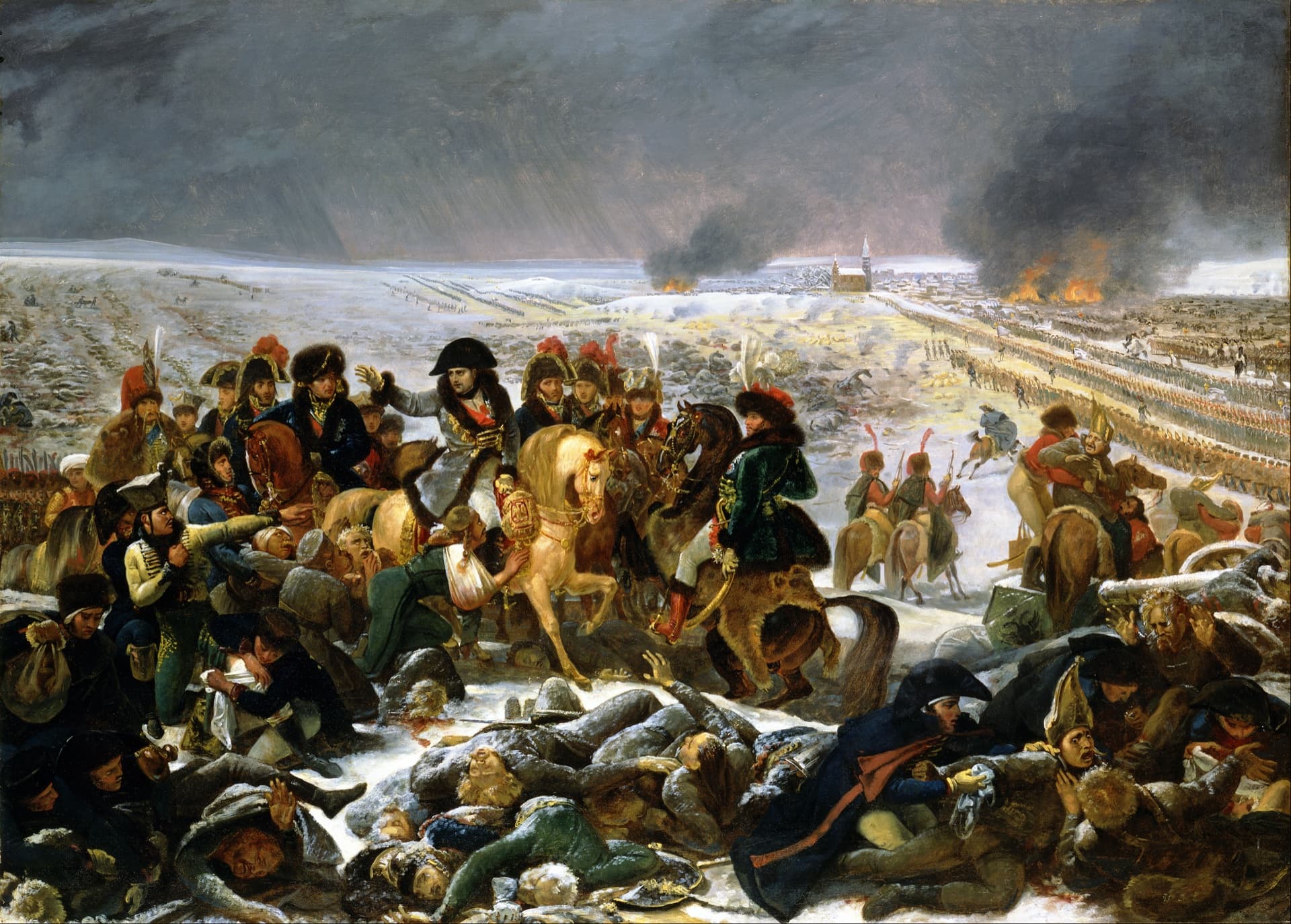
The dead lie frozen and stacked in the snow. Gros painted their faces at twice life size so they read from across the room. This heap fills nearly a third of the canvas.
Eylau was the first battle the Grande Armée did not win, whatever the bulletins said. It ran two days in a February blizzard in East Prussia in 1807, with a cavalry charge sent blind into the snow and a cemetery taken and retaken. At the end the Russians marched away in good order. Both armies stood roughly where they had started, short between 40,000 and 50,000 men. Marshal Ney rode the field afterward and filed the review history kept: what a massacre, and without result. The empire's response was a painting competition. Vivant Denon, who ran the Louvre for Napoleon, set the subject in writing: the emperor visiting the field the next morning. The program fixed the moment, the number of figures, the size of the canvas and the corpses in the foreground. It even named a wounded Lithuanian horseman who was to raise himself and swear service to the man who had spared him. In all, 26 painters entered. Antoine-Jean Gros won it on 13 June 1807, and then delivered more than the program had asked for. Nearly a third of the canvas is a frozen heap of the dead, stacked and blue and painted one man at a time, with faces at twice life size. Surgeons work on the wounded at the left. Above all of it sits the emperor, glove raised, one gesture of mercy over a field of dead. The Salon of 1808 gave Gros a triumph, and Napoleon took off his own cross of the Legion of Honor and pinned it on the painter in front of the picture. What later viewers see is the other painting, the one along the bottom. The empire had asked for the corpses, and Gros painted them so well that they swallowed the mercy above. Every pacifist battle canvas of the next century, down to the trenches, has Eylau's snow in its ancestry. Gros himself never again matched it, declined with the empire he had decorated, and drowned himself in the Seine in 1835. The canvas hangs in the Louvre, 5 metres tall and almost 8 wide, mercy above and the dead below.