Ancient Rome · c. 212 BC
Do Not Disturb My Circles
One old geometer held off the Roman fleet, then a soldier found him drawing
look closer
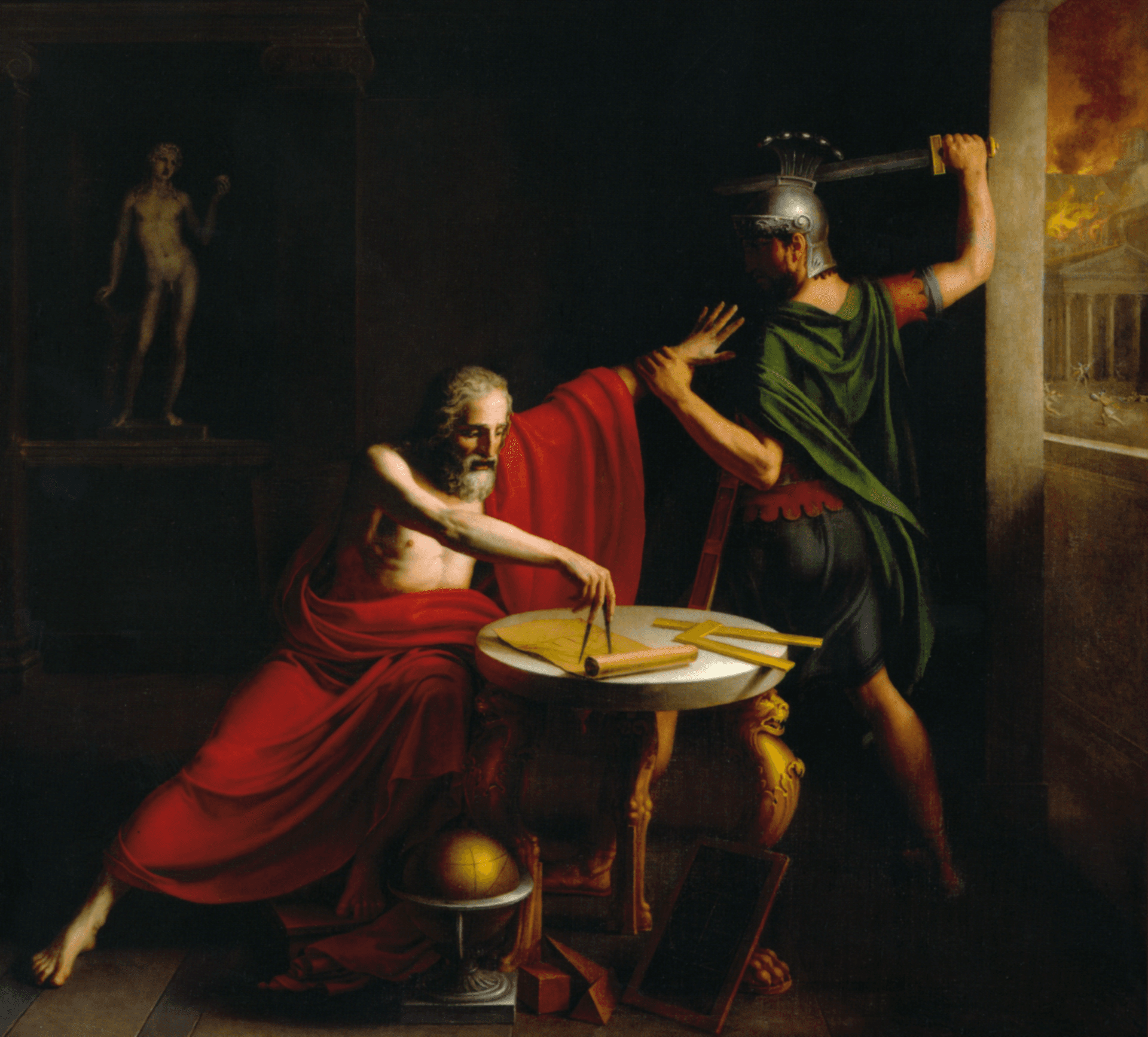
Archimedes sets the point of his dividers on the sheet unrolled across the marble table, a wooden square lying beside it. The soldier’s arm is already in the top corner of the frame.
For most of two years an old man keeps the Roman navy off the walls of Syracuse. Archimedes is past 70 when the general Marcellus lays siege to the Greek city in Sicily in 213 BC, and the machines he has built for his king turn the harbor into a killing floor. Polybius, who talked to men who were there, describes catapults ranged for every distance. He also describes cranes that swing out over the sea and drop iron hands onto the Roman ships. They hoist the bows clean out of the water, then let go, and the hulls smash back and swamp. The assault stalls so badly that Marcellus gives up on storming the place and settles in to starve it. The Romans come to joke bitterly that they are fighting a war against one geometer. Syracuse fell in 212 BC anyway, at night, during a festival, betrayed from inside. Marcellus had given a specific order that the old engineer was to be taken alive and unharmed. It went wrong in the confusion. Plutarch offers three versions of the death and admits he does not know which is true. In one, a soldier orders Archimedes to come, Archimedes asks for a moment to finish a proof, and the soldier runs him through. The line that stuck to the story is a Roman one: noli turbare circulos meos, do not disturb my circles. He is supposed to have said it over a diagram he had drawn in the dust or in a tray of sand. Marcellus was said to be sickened by it and to have looked after the dead man’s relatives. Thomas Degeorge, who had joined David’s studio at 16, painted the moment of it in 1815. Archimedes is bent over a round table with his dividers on an unrolled sheet, a hand up against the soldier, the sword already level. Behind them the sacked city burns orange through the door. The canvas hangs in Clermont-Ferrand, the town where he died. There is a coda that is better than the death. Archimedes had asked to have a sphere set inside a cylinder carved on his tomb, because he was proudest of proving that the sphere is exactly two thirds of the cylinder that holds it. More than a century later a young Roman official posted to Sicily went looking for the grave, which the locals swore was lost. Cicero found it by the marker, a small column above the brush with the sphere and the cylinder still on it, half swallowed by thorns. He had the site cleared. He wrote that the foremost Greek city would have forgotten its most brilliant citizen if a man from Arpinum had not come and shown them his tomb.