Ancient Rome · c. 150 BC
These Are My Jewels
A guest shows off her gems, and Cornelia sends for her sons instead
look closer
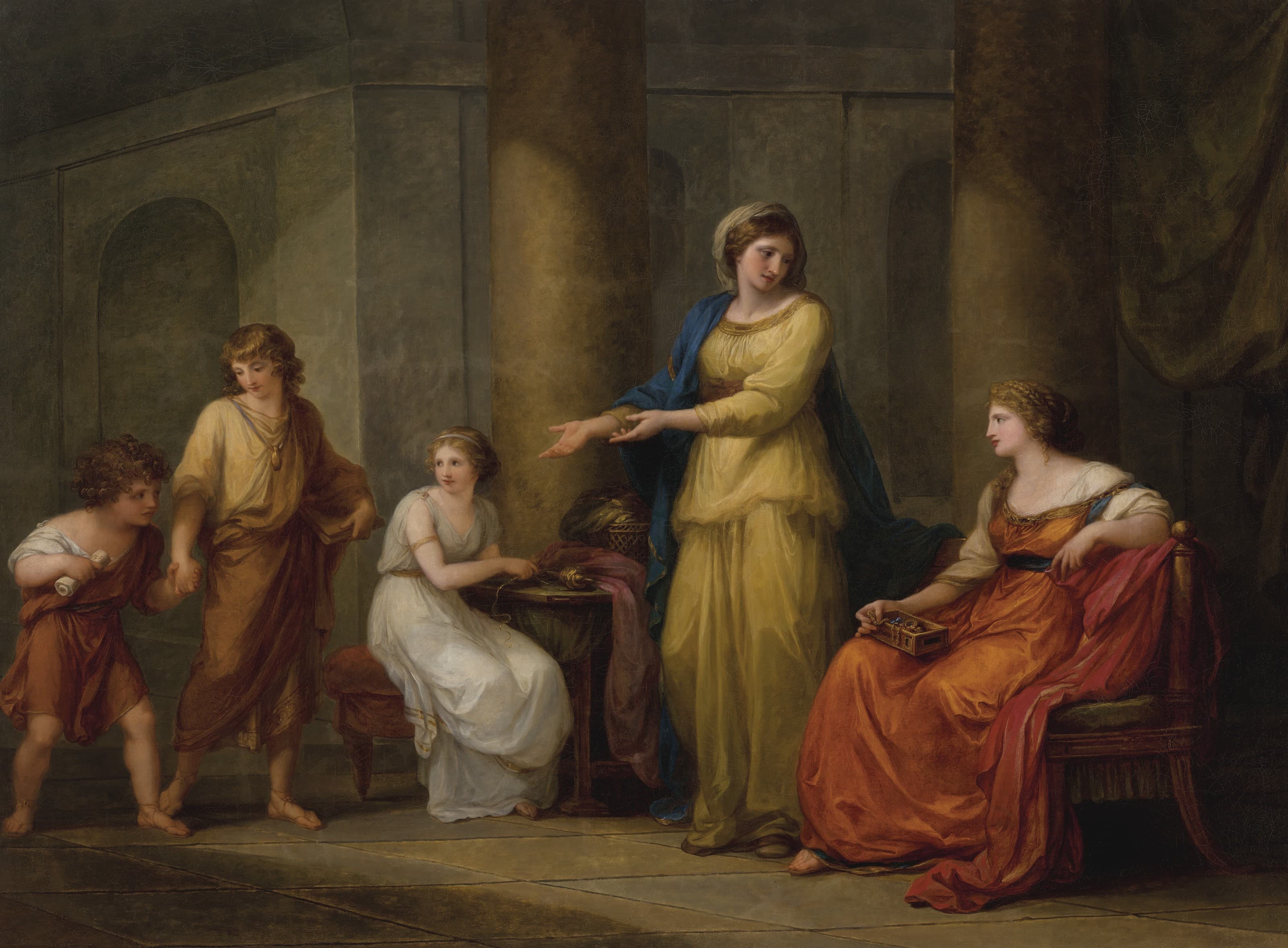
Cornelia turns an open, empty hand out over her daughter Sempronia, who looks up from the worktable. She wears a plain gown and a veil, and there is nothing on her hands or her throat.
A wealthy woman from Campania is visiting Cornelia’s house, and she has brought her jewelry to be admired. She lays it out, the finest gold and stones she owns, and asks to see her hostess’s in return. Cornelia is the daughter of the general who beat Hannibal, the widow of a consul, one of the most respected women in Rome, and she is in no hurry. Valerius Maximus, who tells the story, says she kept the visitor talking until her two sons came home from their lessons. Then she gestured toward the boys walking in and said the line that fixed her in Roman memory: these are my ornaments, meaning her jewels are her children. It is the kind of remark that gets a woman carved into stone, and it did. The trouble is what the boys grew into. Tiberius and Gaius Gracchus became the most dangerous reformers of the Republic, tribunes who tried to hand public land back to the poor and broke every rule of senatorial patience to do it. Both were killed for it. A mob of senators clubbed Tiberius to death on the Capitol in 133 BC and threw his body in the Tiber. Gaius died in another purge 12 years later. The consul who hunted him reportedly paid out the dead man’s head in its weight of gold. Cornelia outlived both her jewels. She retired to a villa on the coast at Misenum, entertained Greek scholars, and spoke of her murdered sons to guests without weeping. She turned down a marriage offer from a king of Egypt to keep her own name. Rome eventually put up the statue, and the inscription that survives calls her not by her husband’s rank but as Cornelia, mother of the Gracchi. Angelica Kauffmann painted the scene in Naples in the 1780s for George Bowles, an English collector who ended up with more than 50 of her pictures. She knew something about being the exception in a room. She was one of only two women among the founders of London’s Royal Academy, and for years the most sought-after history painter in the city. She stages it plainly. The Campanian visitor sits at the right in orange silk with her jewel-box open on her lap, half-turned, still expecting to win. Cornelia stands in the center in plain yellow and reaches toward her children as if presenting the only wealth worth counting. The younger boy clutches a scroll from school. Nobody in the picture yet knows that the two ornaments will be beaten to death by their own government, one after the other, for trying to give Rome’s land to Rome’s poor.