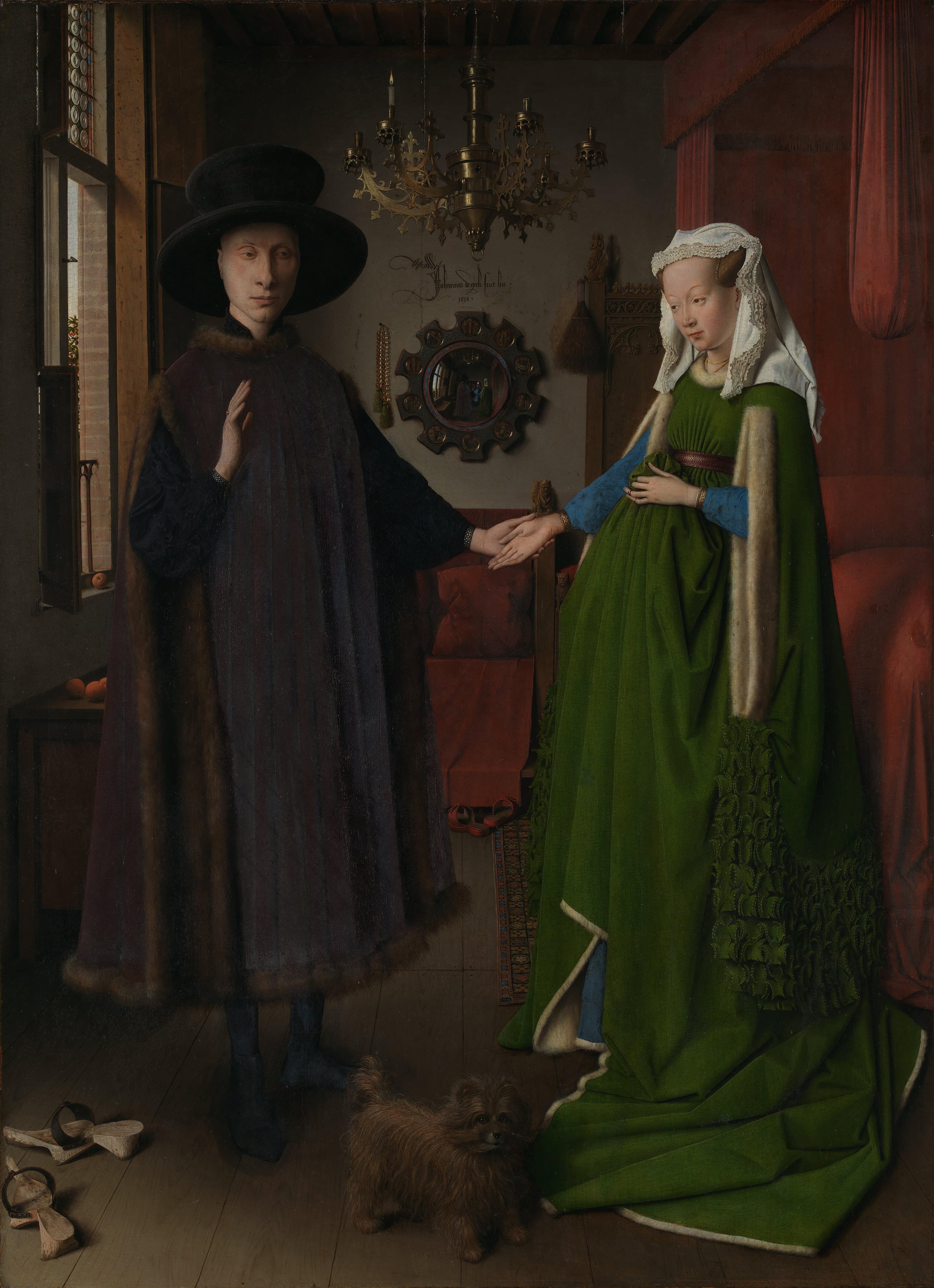
The Renaissance · 1434
Johannes Was Here
In a Bruges bedroom a painter signs the wall like a witness at a wedding
look closer
The convex mirror gathers the whole room and two figures in the doorway. Above it the wall carries a line in a notary's looping hand: Johannes de eyck fuit hic, Jan van Eyck was here.
The room is in Bruges, the year is 1434, and two people are standing very still on a wooden floor. A man in a black hat and a fur-lined cloak holds up his right hand. A woman in a heavy green wool gown rests her hand in his. Her other hand gathers the cloth up over her stomach, the fashion of the day. That has fooled five centuries of visitors into thinking her pregnant. Between them, on the back wall, hangs a convex mirror the size of a saucer. The frame is ringed with 10 tiny roundels, each a scene from the death of Christ. They are painted small enough that reading them means leaning in past the glass. Jan van Eyck put all of this into oil paint, and oil was still close to new. Painters before him mixed pigment into egg, which dried fast and flat. Van Eyck built his pictures in thin films of oil that dried slow and clear, layer over layer. Light seems to pass into the surface and come back out. A brass chandelier reads as brass, a dog’s coat as separate hairs, an orange on the sill as a globe with weight. The oranges are not there for the color. They were a shipped luxury in the wet north, and they say, without a word, that the man in the black hat can afford the impossible in winter. Then there is the mirror, and what is in it. Its curved face gathers the whole room and throws it back small. It holds the two figures seen from behind, the light from the window, and two more people standing in the doorway where the viewer stands. One of them is perhaps the painter. Above the mirror, in the careful looping script of a legal document, van Eyck wrote on the wall: Johannes de eyck fuit hic. Jan van Eyck was here. Not painted this, not made this. Was here, in the past tense, the phrasing a witness signs into a record. One candle burns in the chandelier in full daylight, which no one has ever fully explained, and a small rough-haired dog stands between the couple’s feet and looks straight out. Nobody is certain who the couple are. The old guess names a merchant of Lucca living in Bruges, Giovanni Arnolfini, and a wife. The marriage dates never quite line up, and one scholar noticed the likeliest bride had died before the paint was dry. The picture keeps its secret and offers the mirror instead, a painted eye that has been holding this room, this light, this exact afternoon, since the year the wall said the painter stood in it.