The Renaissance · c. 1427
The Hole in the Wall
A young painter opens a fake chapel in a Florence church, ruled by geometry
look closer
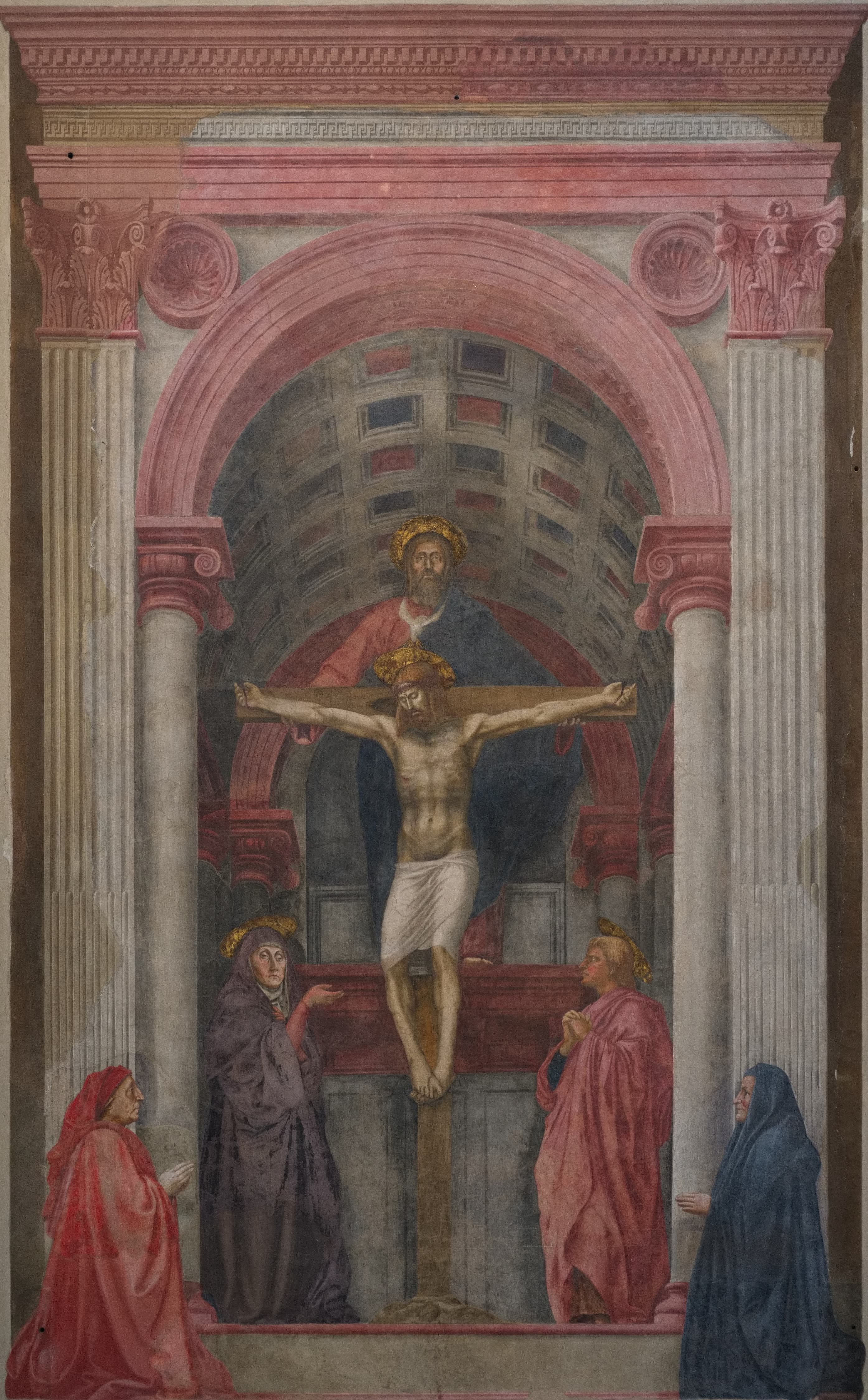
The ceiling is a rounded tunnel lined with sunken square panels. The panels shrink row by row toward one point, and that point sits at the eye level of a person standing in the church. Architects have rebuilt the whole painted room from this fresco as if from a plan, and it holds.
Sometime around 1427 a man stood in the church of Santa Maria Novella in Florence, looked at a flat plaster wall, and saw through it. Tommaso di ser Giovanni, 25 or so, was known to everyone as Masaccio. He had painted a chapel that was not there: a deep barrel vault of coffered stone, going back rank on rank. The Trinity stands inside it, and two patrons kneel on the near lip, on this side of the wall, at the edge of the painted room. There is a single point where all the lines of that vault agree to meet. It sits low, about at the eye level of a person of average height, so that the illusion locks only for someone standing where a real visitor stands. Nobody had painted a wall this way before. The trick was borrowed from an architect. Filippo Brunelleschi, then rebuilding half of Florence, had worked out a method for putting three dimensions onto a flat surface by fixed rules, one horizon, one vanishing point, everything shrinking toward it in proportion. Masaccio took the method into paint. The coffers of the vault are laid out as if measured with a rule and a plumb line. Later students rebuilt the whole architecture from the fresco as though from a blueprint, and it stands up. The figures obey the same discipline. God the Father is a solid old man on a step, holding the crossbar of his son with both hands. Christ hangs as an actual body, ribs and slack weight, a corpse with mass, not the weightless emblem the old painters used. One figure breaks the fourth wall. The Virgin, at the foot of the cross, turns her face out of the picture and lifts one hand toward her son. She is the only person in the scene who looks out of it and asks to be looked at. Below the whole illusion, a skeleton lies on what appears to be a stone tomb. Above it runs a line in the Florentine of the day: I was once what you are, and what I am, you also will be. The measured heaven and the geometry that took a genius to invent both sit on a shelf directly above a plain reminder that the patrons kneeling at the edge are going to end as bone. Masaccio did not live to be old himself. He was dead within a year or two of finishing the wall, at 26, in Rome, of causes nobody wrote down. A rumor of poison followed him, as rumors of poison followed most young men who died in Italy with money owed. His nickname was an insult, roughly big clumsy Tom, given because he cared nothing for his clothes or his debts and everything for the work. A century later the painters of Florence still came to Santa Maria Novella, stood where the geometry wanted them, and watched a flat wall turn into a room. Then in 1570 Vasari built a stone altar across the wall and hung his own Madonna on it, and the Trinity went behind masonry until workmen pulling the altars out in 1861 found it again. The painted skeleton stayed lost longer: it turned up in the north aisle in 1951 and was set back under the vault three years later.