The Renaissance · 1 June 1432
The Sweet Trap
A painter drowns a cavalry battle in perspective and hangs it in a bedroom
look closer
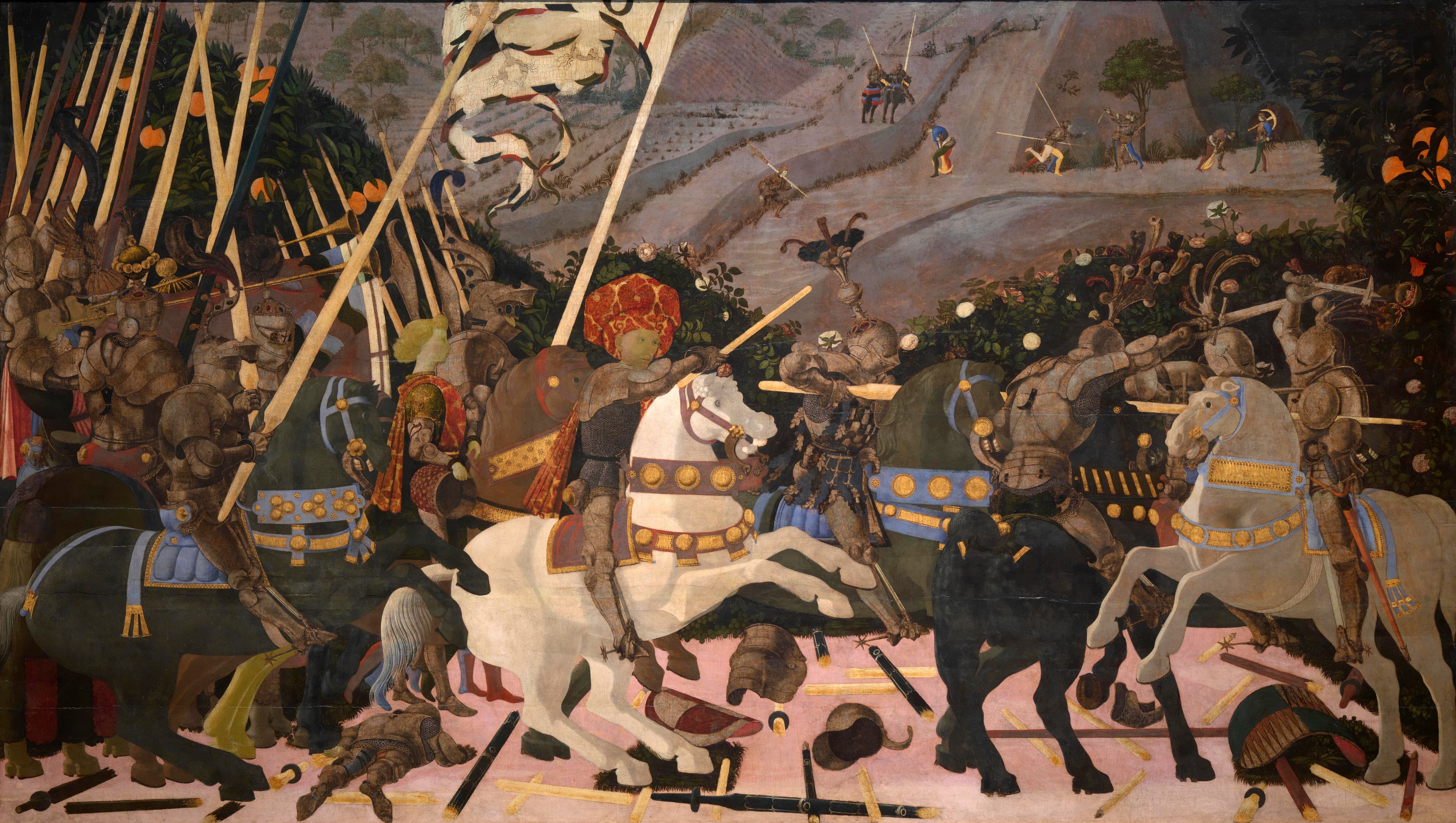
A commander rides at the front of the charge, and he wears a red and gold hat and no helmet. He is Niccolò da Tolentino, the one bare face in the front rank. Behind him a hedge of orange trees closes the fight off from the hillside above.
On the first of June, 1432, near a tower called San Romano, a Florentine army beat a Sienese one after eight hours in the heat. The commander who took the credit was a mercenary named Niccolò da Tolentino. That is the event. What survives of it is stranger than the fight: three long painted panels by Paolo Uccello, made a few years later. In them the battle has been stopped and pinned to the floor like an insect for study. Nothing moves. Everything obeys a grid. Uccello was a perspective man to the point of illness. Vasari tells the story of his wife calling him to bed at night and Uccello staying at his desk over his vanishing points, murmuring, oh what a sweet thing this perspective is. You can see the sweetness turn into a trap in these panels. Broken lances lie on the ground not where lances would fall but where they will best show foreshortening, laid out to converge toward a distant point. A dead soldier at the bottom is laid along the line of sight and shrunk down his own length. Uccello ran the shortening the wrong way. The shoulders came out bigger than the feet, so the body reads back to front against everything else in the panel. The horses look carved. The commander sits on a white one in an enormous curling hat, calm as a man posing. Behind him the fighting climbs a hillside stitched with tiny hunters and fleeing figures the size of a fingernail. The colors have shifted with age into something dreamlike, and the armor was once louder than it is now. Uccello laid silver leaf into the armor and gold into the harness, so that a viewer holding a candle would have seen the helmets catch fire in the dark. The silver has since oxidized to a dull grey. The panels were tall, expensive, and built to wrap a room. By 1492 an inventory of the Medici palace lists all three hanging together in a ground-floor room that had become the bedroom of Lorenzo the Magnificent. He wanted them so badly that the earlier owners were, by some accounts, leaned on to give them up. A battle scene as bedroom furniture, for the most powerful man in Florence to sleep beneath. Uccello himself ended poorly. In a tax return late in life he wrote that he was old, without means to work, his wife ill, and he could no longer see. The man who had spent his nights chasing the exact rate at which the visible world shrinks toward a point went blind at the end of it. The three panels are scattered now, one in Florence, one in London, one in Paris, and no museum will lend them. The battle Uccello locked into geometry has never once been put back into the single room he built it to fill.