The Renaissance · c. 1474
The Profile of Urbino
A duke turns his good side to us and lets the painter keep the broken nose
look closer
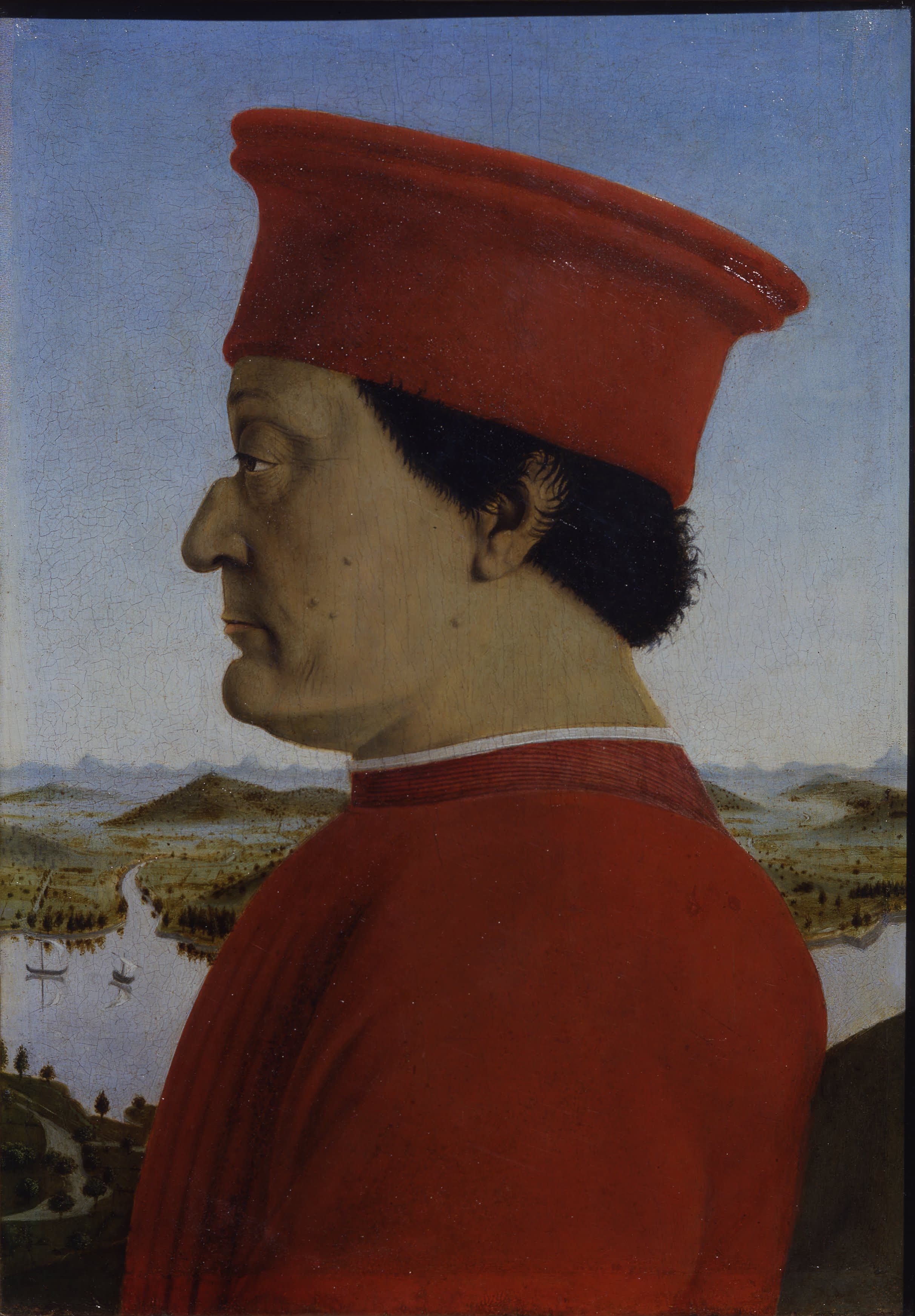
The bridge of the nose drops into a notch. A lance came through Federico’s visor in 1450 and took the right eye with it, and Piero painted the damage without smoothing it away.
The Duke of Urbino is showing you his left side, and there is a reason. Around 1474 Piero della Francesca painted Federico da Montefeltro in strict profile, red cap, red robe, against a pale valley of rivers and little hills that dissolve into blue distance. Federico had lost his right eye and the bridge of his nose in a tournament in 1450, when a lance came through his visor. From then on he was painted, and coined, and carved, only from the left. A later legend even had him ordering a surgeon to cut away part of the damaged nose, so his one remaining eye could see past it to the right. No record from the time says so. Piero paints exactly that face. The bridge of the nose has a deep, unnatural notch. The painter did not smooth it out. Everything else in the head is kept just as plainly. The skin is a map of a working life: moles, warts, the stubble along the jaw, the creases of a man in his fifties who had spent 30 years as a soldier for hire. Federico made his fortune as a condottiere, a mercenary captain the Italian states rented by the season, and he was reckoned one of the best and one of the few who kept his contracts. With the money he built one of the most admired courts in Europe at Urbino, and a library he meant to rival the pope’s. He filled it with hand-copied manuscripts, because he is supposed to have said a printed book would have shamed him. Behind the profile, the land goes on for miles. Piero was as much a mathematician as a painter, and he wrote books on perspective and on the geometry of solids. He built the distance here the slow way the northern painters did. Colors cool and soften as they go back, until the far hills are the same blue as the sky. Down in the valley, along the winding water, there are two boats. They are tiny pale sails at the far left edge, well below his shoulder, put there for no reason the picture needs. The portrait is half of a pair. On the matching panel Piero painted Federico’s wife, Battista Sforza, face to face with him across the frame. On the backs of both he added small triumphal processions in the antique manner, so the whole thing folds shut like a book of two rulers. Battista was already dead when it was made, gone at 26, months after finally giving Federico a son. He turns his ruined, honest profile toward her across the gap, and she keeps her chalk-white face turned to his, the two of them fixed in the one direction the duke could safely be seen.